Is contact lens power the same as sphere?
Yes. On a contact lens prescription, power and sphere are the same value — one number per eye, stated in diopters.
The confusion is a labelling artefact, not an optical one. A box may print PWR, an order form may print SPH, a lab form may print D, and all three carry the identical figure: the spherical power of the lens. When someone says their power is −3.25, they are quoting the sphere. When a form asks for sphere and the box says PWR, nothing needs converting between them.
Where the two words genuinely part company is one level up. Sphere is also the name of a field on a spectacle prescription, and that field holds a different number from the one a contact lens is ordered in. So the question has a clean yes for the lens in your hand and a firm no across the two prescriptions — which is the rest of this page.
Which labels mean sphere on a contact lens?
Six labels carry the same field: PWR, PWR-D, SPH, P, D, and BVP.
- PWR / PWR-D / P / D — manufacturer variants of “power”. Same field, same units.
- SPH — sphere. The spectacle prescription's name for the field, borrowed onto contact lens forms.
- BVP — back vertex power. Not a different quantity, but a statement of where the power is measured: at the back surface of the lens, the side nearest the eye. It is the reason vertex distance matters at all.
Two conventions travel with the field. The sign is part of the value — a minus number corrects myopia, a plus number corrects hyperopia, and dropping the sign changes the prescription rather than shortening it. And a sphere of zero is often written plano or PL rather than 0.00; on a toric or multifocal order that is a real, ordered value, not a blank.
Every one of these prints one figure per eye. If a field holds two numbers, one of them is not sphere. The complete field-by-field walk through a printed label is on how to read the printed label.
What sphere does not include
Sphere is the whole correction only on a spherical lens. Three further fields sit outside it, and two more are not power at all.
- CYL — cylinder, the astigmatic power, printed only on a toric lens. Read what CYL means.
- AX — axis, the meridian the cylinder sits on. Read what axis means.
- ADD — the near addition on a multifocal, usually a LOW, MED or HIGH designation. Read the add designation.
- BC and DIA — base curve and diameter. Geometry, in millimeters, fitted on eye and never derived from a refraction. Read Base Curve of Contact Lenses and Diameter of Contact Lenses.
Reading cylinder as though it were part of the sphere is the usual misreading of a printed prescription, and it is why a toric order is written as sphere / cylinder / axis rather than as one number. A −2.00 / −0.75 × 180 lens is not a −2.75 lens.
Is the sphere on your glasses the sphere you order?
No — not once the power reaches the vertex gate. A spectacle sphere is measured about 12 mm in front of the cornea, and moving that correction onto the eye changes how much power it takes to do the same job.
This site applies vertex compensation at or above ±4.00 D, using 12 mm as the convention when the actual vertex distance was not measured. Below that gate the difference rounds away inside the ordering step and the spectacle sphere is used as written; at and above it, the two numbers separate far enough to matter.
The direction is fixed and worth committing to memory. A minus spectacle lens gains effective power at the cornea, so the ordered contact lens is less minus. A plus spectacle lens loses effective power at the cornea, so the ordered contact lens is more plus. Both moves run the same way — toward more plus — because both are the same geometry seen from opposite signs.
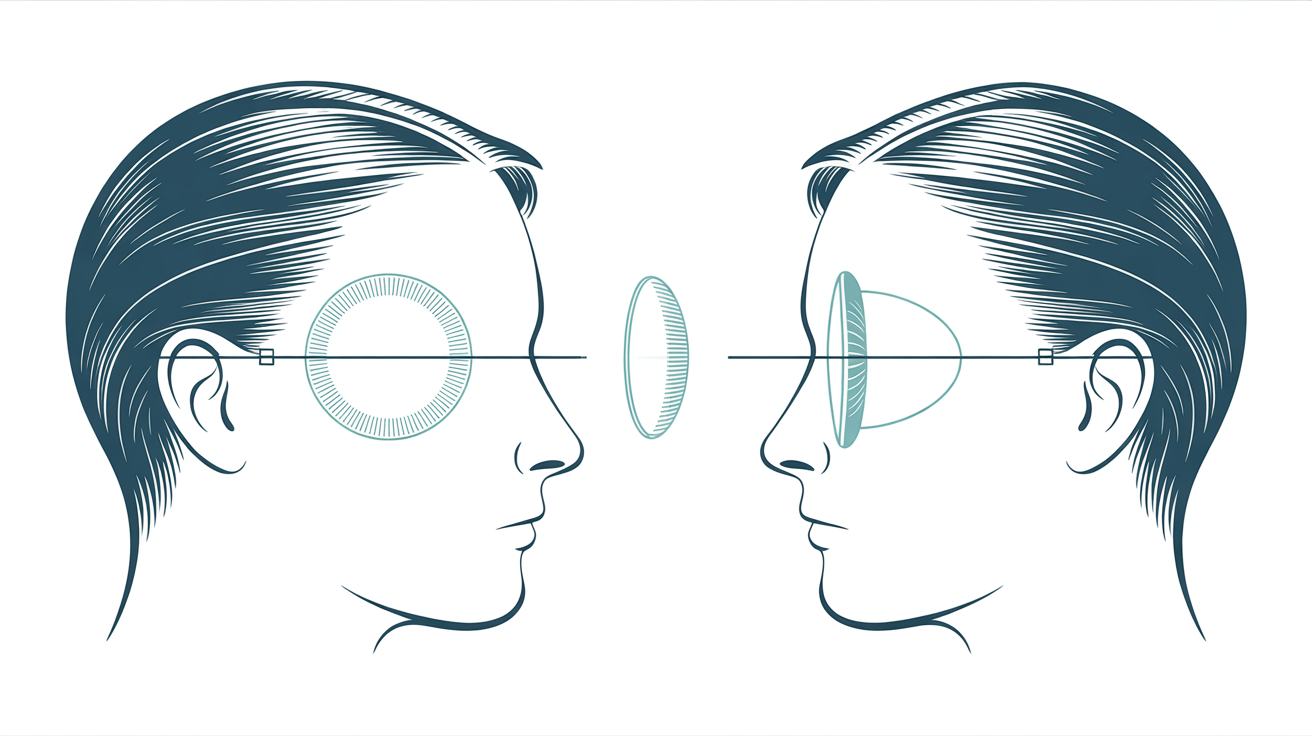
Convert the actual numbers on the Contact Lens Conversion Calculator, or work a single power with vertex-compensated contact lens power. This page states the relationship; it does not compute it.
How far apart do the two numbers get?
Far enough that the ordered lens is a different lens. The table below is computed from the same module the calculators use, at the 12 mm convention, rounded to the 0.25 D step lenses are manufactured in.
| Spectacle sphere | At the corneal plane | Ordered at the 0.25 D step |
|---|---|---|
| −4.00 | −3.82 | −3.75 |
| −6.00 | −5.60 | −5.50 |
| −8.00 | −7.30 | −7.25 |
| −10.00 | −8.93 | −9.00 |
| +4.00 | +4.20 | +4.25 |
| +6.00 | +6.47 | +6.50 |
| +8.00 | +8.85 | +8.75 |
Read the −10.00 row before any other. A patient who orders that spectacle sphere as written is a full dioptre over-minused — enough to produce accommodative strain and blur that no base curve change will fix, on a lens that is otherwise fitting correctly. The +8.00 row makes the mirror-image point in the other direction.
Two details in that table are worth naming. The compensated value is almost never on the 0.25 D grid, so the ordered column is a second, separate step — the compensated figure is rounded because that is what is manufactured, not because the arithmetic ended there. And the rounding does not always move the same way: −8.93 rounds outward to −9.00 while the −8.00 row rounds inward to −7.25.
A high prescription is where that separation is widest, and the compensated range this site tabulates runs from −4.00 to −20.00 D on the minus side and +4.00 to +16.00 D on the plus side. The full range is tabulated on the Contact Lens Conversion Chart, and the formula and its bounds are documented on How we calculate.
Why the two numbers differ at all
The eye did not change. The plane changed.
A lens bends light by a fixed amount, but how much correction that delivers to the eye depends on how far in front of the eye it sits. Move the same lens closer and its effective power at the cornea changes. The relationship is Fc = Fs ÷ (1 − d × Fs), with d the vertex distance in meters — a compact expression of the fact that a spectacle lens works at a distance and a contact lens does not.
That is also why back vertex power is the label some manufacturers print: it states that the figure is measured at the back surface of the lens, which is the surface the distance is measured from. Read Vertex Distance of Contact Lenses for the optics.
Nothing about the material, the base curve or the diameter appears in that formula. A −6.00 D spectacle sphere lands on the same corneal-plane value in a hydrogel, a silicone hydrogel or a rigid lens — read what contact lenses are made of for why the material still constrains what can then be ordered.
Does sphere mean power on a toric or multifocal order?
Yes, and it stays a separate field from the others.
On a toric order, sphere is still the spherical component. What changes is that the compensation is not applied once: each principal meridian is vertex-compensated separately, and the ordered cylinder is what remains between the two compensated meridians. Axis does not move — the plane change alters power, not orientation. Calculate starting SPH, CYL and AX on the Toric Contact Lens Calculator.
Where the cylinder is low, a spherical equivalent — sphere plus half the cylinder — is sometimes used to order a spherical lens instead. That is a decision about which lens to fit, taken after compensation and not instead of it; the arithmetic is on the Spherical Equivalent Calculator.
On a multifocal order, sphere is the distance power and the near addition is a separate designation. Starting add belongs on the Multifocal Contact Lens Calculator; what LOW, MED and HIGH mean is on the add designation.
What confirms the sphere you ordered
An over-refraction through the trial lens is what confirms it. Nothing before that point is a finished number.
Compensation predicts the starting sphere from a measurement taken at a different plane. Once a lens is on the eye, the residual refraction through it is measured directly, at the plane that matters, on the eye that has to wear it — and that measurement supersedes the prediction. Where they disagree, the over-refraction wins.
Read the Over-Refraction Calculator for the method and the arithmetic that folds the result back into the ordered power.
Starting contact lens parameters still require on-eye fit
A compensated sphere is a starting parameter, not a prescription.
It assumes a 12 mm vertex distance that was probably not measured, it rounds to a step the manufacturer offers, and it says nothing about whether the lens will centre, move or stay comfortable for eight hours. Those are chairside findings.
Patient aside (Grade 8–9)
The number on your glasses is not the number on your contact lenses, especially if your prescription is stronger than about ±4.00. Contacts sit on your eye and glasses sit in front of it, so the same correction needs a slightly different strength. Do not order contacts using the numbers from your glasses.
Read Starting Contact Lens Parameters Are Not a Prescription for the bound that applies across this site, and for whether a glasses prescription can be used for contacts at all. Convert spectacle prescription to contact lens parameters for power. Fit base curve and diameter on eye. Verify power with over-refraction after the trial lens. Contact lens parameters at the corneal plane stay unfinished until that sequence is done.
Sources
Every diopter figure on this page is computed at build time; none is typed into the copy.
- This site's conversion module — the ±4.00 D vertex gate (inclusive), the 12 mm default vertex distance, the 0.25 D ordering step, and Fc = Fs ÷ (1 − d × Fs). The divergence table renders from that module, so it cannot drift from the calculators.
- How we calculate— the formula, its bounds, the rounding rule, and the singular case the module refuses to compute.
- Lens.com, Back Vertex Power in Contact Lenses— back vertex power as the effective power of a lens measured at its back surface, the side nearest the eye.
- Vertex distance— the effective-power relationship between the spectacle plane and the corneal plane. Attributed in full on Vertex Distance of Contact Lenses, so the pages agree rather than each asserting the optics independently.
Published Last updated Report a correction