What is vertex distance of a contact lens?
Vertex distance is the space between the back of the spectacle lens and the front of the cornea.
A contact lens sits on the cornea, so its vertex is essentially zero. Spectacle lenses commonly sit about 12 to 14 mm from the cornea, the spectacle plane this conversion leaves. The same dioptric label at 12 mm in front of the eye does not produce the same effective power once the lens rests on the cornea. Back vertex distance is the measured name for that gap. It is the d in the formula below.

Why is vertex distance important for contact lenses?
Vertex distance changes effective power from the spectacle plane to the corneal plane, so glasses power is not contact lens power.
Increasing or decreasing that gap moves the focal point relative to the eye and changes the power the retina receives. A contact lens is worn with virtually no vertex distance. A refraction is taken at the spectacle plane. Vertex compensation converts the spectacle-plane refraction into corneal-plane starting power so the ordered contact lens matches the intended retinal image. The change stays under a 0.25 D manufacturing step for many low meridians. It becomes clinically meaningful once meridional powers are at or above about ±4.00 D. High myopia, high hyperopia, and anisometropia are the three settings where that divergence shows up in acuity or binocular balance. Spectacle as-worn vertex, pantoscopic tilt, and wrap are a different dispensing job. This page converts power to the corneal plane.
Calculate the compensated meridians on the Contact Lens Vertex Calculator and Distance Chart. That URL holds the working tool and the 12 mm chart. This URL holds the why.
What is the back vertex power formula for contact lenses?
Back vertex power for a contact lens is calculated as Fc = Fs ÷ (1 − d × Fs), with d in meters (0.012 at 12 mm).
Formula block
Fc = Fs ÷ (1 − d × Fs)
Fc is corneal-plane (contact lens) power in diopters. Fs is spectacle-plane power in diopters. d is vertex distance in meters. At the 12 mm default, d = 0.012. A contact lens final vertex is 0, so d equals the spectacle vertex you enter.
Clinical references write the same algebra under three labels: vertex compensation, effective power at a new plane, and back vertex power. Thick-lens front vertex power versus back vertex power is a different laboratory measurement of a lens in air. It is not this conversion.
The following steps convert a written spectacle power into starting contact lens power.
- Write the spectacle power as written.
- Set vertex distance in millimeters (default 12).
- Convert d to meters (12 mm = 0.012 m).
- Calculate Fc, then round to the nearest 0.25 D for the manufacturing step.
Those four steps are the back vertex power formula in chairside order. Sphere-only input is enough for a spherical Rx. A toric Rx still needs both meridians, reconstructed after the same formula. For a non-12 mm refraction, keep the measured millimeters; the algebra does not change. Isolate the numbers on the vertex calculator already named above.
Clinical takeaway
Calculate Fc at the stated vertex, show unrounded and 0.25 D starting power, then fit on eye. The formula is the method. The chart is the formula in lookup form.
What is a normal vertex distance?
A normal clinical stand-in for an unlisted back vertex distance is 12 mm.
This site defaults to 12 mm for any refraction without a measured back vertex distance. Independent conversion references use 12 mm as a common default. Manufacturer fitting tools that apply 12 mm across each power meridian use the same stand-in. Spectacle lenses commonly sit about 12 to 14 mm from the cornea. Phoropter vertex is about 13.75 mm. Trial frames run about 10 to 16 mm by fit and frame style. Enter the measured millimeters when the refraction lists another value. The 12 mm default is not a claim that every phoropter sits at 12 mm. This page does not adopt a 14 mm prefill or a 10 mm phoropter example as the site default. The methods page How We Calculate Starting Contact Lens Parameters records the same 12 mm rule.
The following table restates those vertex distances in one place.
| Lens or instrument | Vertex distance |
|---|---|
| Contact lens | Essentially zero (on the cornea) |
| Spectacle lens | About 12 to 14 mm |
| Phoropter | About 13.75 mm |
| Trial frame | About 10 to 16 mm |
When does vertex compensation change the ordered sphere?
Vertex compensation changes the ordered sphere for meridional powers at or above about ±4.00 D.
The vertex change often stays under a 0.25 D manufacturing step below about ±4.00 D and leaves the ordered sphere alone. Around ±4.00 D the difference becomes more than 0.25 D, per Wikipedia, Vertex distance. Apply the formula to each meridian of a toric Rx, not only to the written sphere. Three 12 mm pairs already recomputed from Fc = Fs ÷ (1 − 0.012 × Fs), rounded to the nearest 0.25 D:
- −4.00 D spectacle starts at −3.75 D
- −6.00 D spectacle starts at −5.50 D
- +6.00 D spectacle starts at +6.50 D
Those three pairs sit at the edge of the gate and at the usual chairside checks. The full 12 mm table lives on the vertex calculator already named above. Convert this spectacle Rx to starting contact lens parameters on the Contact Lens Conversion Calculator. That tool takes the vertexed sphere into the rest of the conversion path.
How do plus and minus spectacle powers change at the cornea?
Minus spectacle lenses convert to less minus starting contact lens power; plus spectacle lenses convert to more plus.
A minus lens gains effective power as it moves onto the cornea, so the ordered contact lens is weaker in minus than the glasses Rx. −4.00 D at 12 mm becomes −3.82 D unrounded, −3.75 D after the 0.25 D step. −6.00 D becomes −5.60 D unrounded and −5.50 D rounded. −10.00 D becomes −8.93 D unrounded, −9.00 D rounded. Ordering a −6.00 D contact lens for a −6.00 D spectacle Rx leaves the eye over-minused at the corneal plane.
A plus lens loses effective power as it moves onto the cornea, so the ordered contact lens is stronger in plus than the glasses Rx. +4.00 D at 12 mm becomes +4.20 D before rounding and +4.25 D after. +6.00 D becomes +6.47 D unrounded and +6.50 D rounded. +10.00 D becomes +11.36 D unrounded, +11.25 D at the manufacturing step. Ordering a +6.00 D contact lens for a +6.00 D spectacle Rx leaves the eye under-plussed at the corneal plane.
How is back vertex distance measured on a refraction?
Back vertex distance is the d in Fc = Fs ÷ (1 − d × Fs), measured from the spectacle-lens back surface to the cornea.
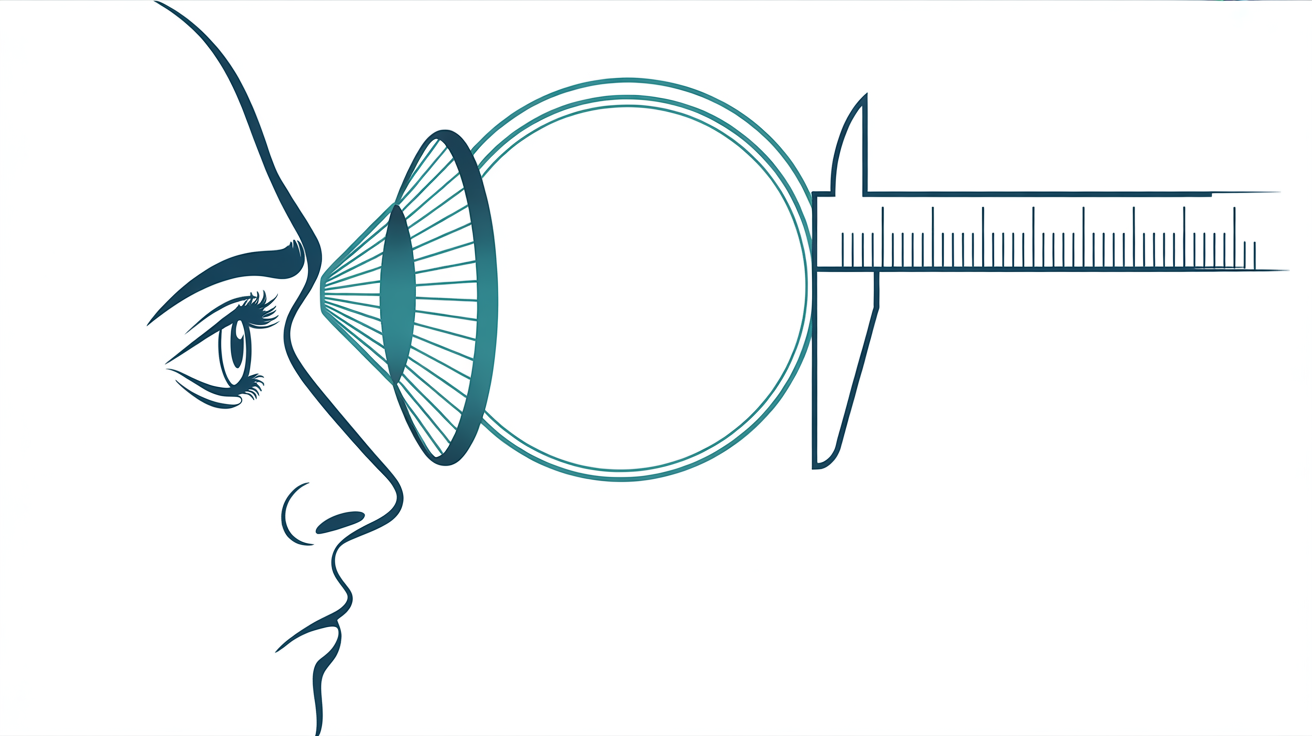
The following three methods record that gap in millimeters.
- Read a listed BVD on the refraction and enter that value.
- Measure with a distometer from the closed lid or cornea to the lens back surface.
- Measure with a millimeter ruler to the lens back surface, then add 1.0 mm for eyelid thickness on a closed-eye reading.
A distometer is the dedicated chairside tool for that gap. A ruler reading that starts at the front of the lens still subtracts lens thickness before it is a back vertex distance. Phoropter vertex is about 13.75 mm. Trial frames run about 10 to 16 mm. This site still defaults to 12 mm unless you enter a measured BVD. Use the measured value when you have one.
Patient aside (Grade 8 to 9)
Your glasses sit a little in front of your eye. A contact lens sits on the eye. That's why the two numbers differ. The formula on this page is not a mail-order prescription. A licensed fitter still puts a trial lens on and checks the power.
What should you do after you understand vertex distance?
After you understand vertex distance, calculate Fc, convert the rest of the Rx, fit the trial lens, and verify with over-refraction. The following four steps are that sequence in order.
- Calculate Fc on the vertex tool at the stated millimeters.
- Convert the remaining spectacle prescription to starting contact lens parameters.
- Fit the diagnostic or trial lens on eye.
- Verify power with over-refraction after the trial lens.
Understanding the plane change without a calculated Fc still leaves a paper glasses number. Calculating without a trial lens still leaves a paper contact lens number. High powers and anisometropia make residual sphere or cylinder obvious. A toric Rx still needs each principal meridian converted before cylinder is reconstructed. Calculate a toric starting power on the Toric Contact Lens Calculator after both meridians are vertexed. Use the Over-Refraction Calculator for Contact Lens Parameters once the trial lens is on eye.
Verify with over-refraction after the trial lens.
Vertex distance questions
What does vertex mean on an eye prescription?
Vertex on an eye prescription is back vertex distance, the millimeters from the spectacle-lens back surface to the cornea at the refraction.
BVD 12 means that refraction was measured at 12 mm. Override the site default when the Rx lists another value.
When is vertex compensation required for contact lenses?
Vertex compensation is required for meridional powers at or above about ±4.00 D.
Below that gate the change often stays under 0.25 D. The formula still shows the math.
How do you find vertex distance at the chair?
Vertex distance is found by reading a listed BVD or by measuring from the cornea to the lens back surface with a distometer or a millimeter ruler.
Add 1.0 mm for eyelid thickness on a closed-eye ruler reading. Enter the measured millimeters on the vertex calculator.
What is used to measure vertex distance?
A distometer is the dedicated tool used to measure vertex distance; a millimeter ruler (PD ruler) is the other chairside method.
Both measure from the closed lid or cornea to the lens back surface. Add 1.0 mm for eyelid thickness on a closed-eye ruler reading. A ruler reading that starts at the front of the lens still subtracts lens thickness before it is a back vertex distance. Phoropter vertex is about 13.75 mm. Trial frames run about 10 to 16 mm. Spectacle lenses commonly sit about 12 to 14 mm from the cornea. This site still defaults to 12 mm unless you enter a measured BVD.
How is residual contact lens power vertexed after corneal refractive surgery?
Vertex compensation applies to the spectacle over-refraction for residual error, not to the corneal ablation.
Use the residual spectacle refraction as Fs. Apply the same ±4.00 D meridional gate. Do not vertex the surgical correction itself. This page is contact lens parameters at the corneal plane. It is not an IOL or excimer calculator.
Starting contact lens parameters are not a prescription
Starting contact lens parameters from the vertex formula are not a prescription. Independent professional judgment still decides the ordered lens after on-eye fit. Educated patients who searched a back vertex power formula do not self-prescribe from Fc.
Calculate vertex-compensated contact lens power, convert spectacle prescription to contact lens parameters, and keep those contact lens parameters at the corneal plane until a fitter verifies them. Read Starting Contact Lens Parameters Are Not a Prescription for the bound that applies across this site.
Not a Rx
Not a prescription / on-eye next step
The formula returns a diagnostic starting point. Fit the trial lens. Verify power with over-refraction after the trial lens.
Sources
Clinical claims on this page are attributed to the publications below. Formulas were recomputed independently; manufacturer tools are cited as references, not as affiliations.
- Wikipedia, Vertex distance— back surface of a corrective lens to the front of the cornea; refractions at 12–14 mm; around ±4.00 D the difference becomes more than 0.25 D; equivalent formula Fc = (F⁻¹ − x)⁻¹ (published here as locked Fc = Fs ÷ (1 − d × Fs)); more plus / less minus as glasses move farther. Wiki derivation not pasted as a second formula.
- OpticalTraining, Understanding Vertex Distance— cornea-front to lens-back definition; distometer and PD-ruler method; add 1.0 mm for eyelid thickness on a closed-eye measure. Their ±7.00 D significance claim not used as the site gate. 10.00 D / 5 mm rule of thumb not used as a substitute for Fc.
- ODReference Vertex Distance Calculator and Power Chart— 12–14 mm spectacle plane; ±4.00 D meridional gate; Fc = Fs ÷ (1 − d × Fs) with d = 0.012 m; minus less minus / plus more plus; −6.00 D near −5.50 D and +6.00 D near +6.50 D (verified by recomputing Fc); 0.25 D rounding; BVD; phoropter ~13.75 mm; trial frames about 10–16 mm; 12 mm common default; starting point + over-refraction; residual post-surgery vertex of the spectacle over-refraction.
- Omni Calculator Contact Lens Vertex Calculator— equivalent Fc relationship with d in meters; contact lens final vertex = 0 so d equals spectacle vertex; BVD 12 FAQ (refraction measured at 12 mm). Omni’s ±0.13 D tolerance sentence is not used here.
- Lens.com, What Is Back Vertex Power in Contact Lenses— BVP = F / (1 − d · F) with d typically 12 mm / 0.012 m. Thick-lens FVP/BVP mix not taught as a second formula. Shopping CTAs not used.
- Healio / Holladay, Vertex distance important for many power calculations— vertex from posterior spectacle surface to corneal vertex; magnitude greater than 4 D; “usually about 12 mm.” Excimer / phakic IOL formulas and surgical over-refraction protocol not used. One disambiguation sentence only.
- OpticianWorks, Vertex Distance— contact lens worn with virtually no vertex distance; compensation above ±4.00 D; distometer. 10 mm phoropter example and 10–14 mm refraction range not used as default. Tear-film minus-lens aside not adopted.
- Chadwick Optical Effective and Compensated Powers— clinically important at typically ±4.00 D or greater for contact lens fittings.
- Johnson & Johnson Vision ACUVUE Fitting Calculator— 12 mm vertex calculation across each power meridian. Not an ACUVUE SKU picker on this site.
- Art Optical Vertex Adjustments— 12 mm clinical heading.
- 2020Calcs Vertex Calculator— prefilled 14 mm. Not used as our default.