Clinical takeaway
This calculator verifies starting contact lens parameters by calculating residual error through the trial lens. Output is the next diagnostic power, not a prescription.
Not a Rx
Not a prescription / on-eye next step
A licensed fitter confirms base curve, diameter, material, and ordered power on eye. Unstable rotation is a fit problem first.
What is over-refraction in contact lens practice?
Over-refraction in contact lens practice is the residual refraction measured through a contact lens on eye.
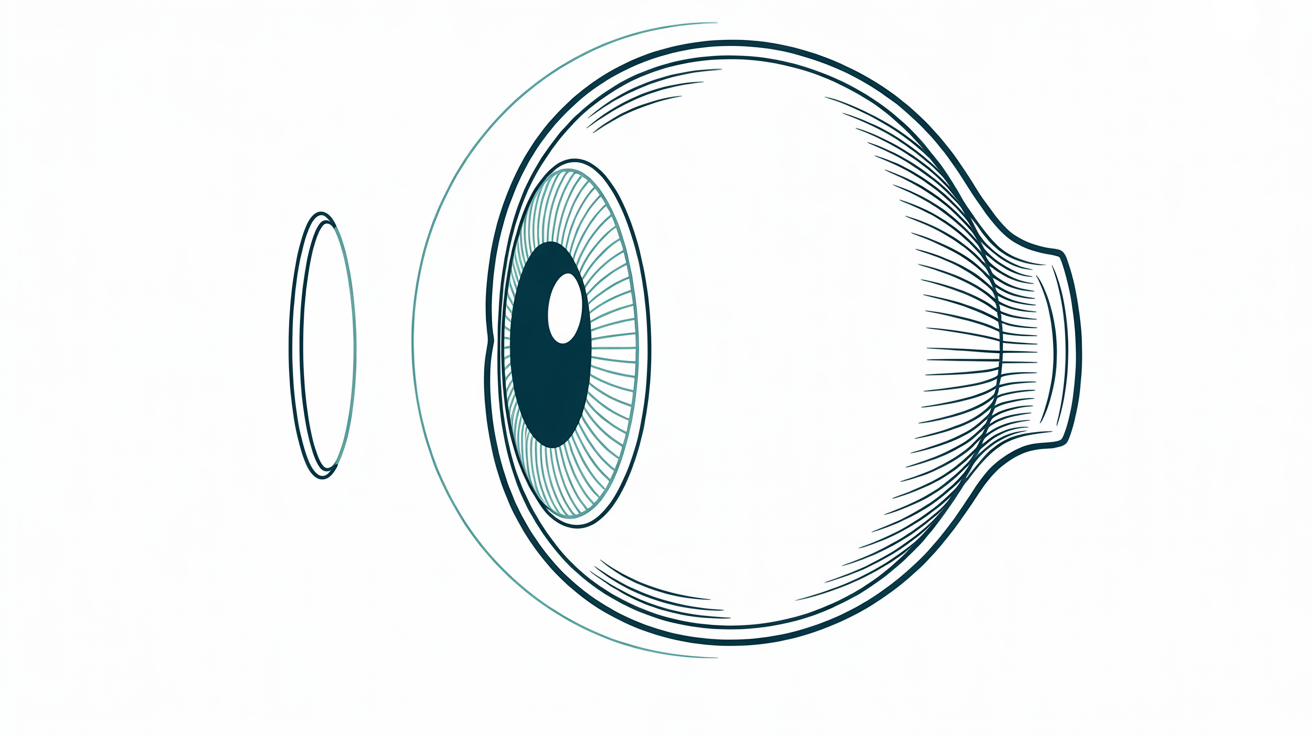
According to Moran CORE, Contact Lens Over-Refraction (Noell Acord, OD, and David Meyer, OD, FAAO, dated 6/30/22), common practice at fittings and follow-ups is to perform an over-refraction over the contact lens to reach a maximum visual outcome. That page names two measurement choices: spherical over-refraction (SOR) versus spherocylindrical over-refraction (SCOR), and loose lenses versus the phoropter.
Loose-lens over-refraction in free space is the efficient path when the patient is seeing well. According to the same Moran CORE page, start by showing more plus over the uncovered eye and continue until maximum plus for maximum visual acuity is reached, then confirm binocularly. The phoropter is the efficient path when vision is not optimal or a SCOR is expected. Moran CORE notes that the phoropter may induce proximal accommodation and advises confirming phoropter findings in free space.
Over-refraction verifies the power that spectacle-to-contact conversion started. Run that upstream conversion on the Contact Lens Conversion Calculator when the trial lens itself still needs a corneal-plane starting sphere.
Takeaway: over-refraction is a verify step on eye, not a replacement for the glasses-to-contact conversion.
What starting parameters does this over-refraction calculator return?
This calculator returns the next starting sphere, cylinder, and axis, plus the vertex distance used on the over-refraction.
The following four values make up that starting set:
- Next sphere after combining trial power with residual sphere
- Cylinder after spherocylindrical over-refraction and any cross-cylinder combination
- Axis kept between 001 and 180
- Vertex distance in millimeters, with a flag for whether the over-refraction was vertex-compensated
Those four fields are diagnostic starting power for the next trial. They are not a manufacturer SKU. The result panel shows the unrounded combination beside the 0.25 D rounded pair so the method is visible.
A toric trial is the usual input set when cylinder or rotation is in play. Calculate that trial’s starting cylinder and axis first on the Toric Contact Lens Calculator. This URL owns residual-error math after the lens is on eye.
Takeaway: the returned SPH/CYL/AX set is the next trial start, not an ordered Rx.
How do you calculate spherical over-refraction after the trial lens?
Spherical over-refraction after the trial lens is calculated when the lens is stable and the residual error is sphere-only.
The following sequence is that spherical path:
- Confirm rotation and stability before measuring power.
- Use loose lenses or a flipper for spherical over-refraction when acuity is already good.
- Add plus toward maximum plus for maximum visual acuity, one eye at a time.
- Confirm the change binocularly in free space.
- Add the spherical over-refraction to the trial sphere when axes match and rotation is zero.
According to Contact Lens Spectrum, The Contact Lens Exam (Jeff Schafer, OD, MS, FAAO, June 1, 2007), evaluate the lens fit before attempting an over-refraction, and proceed only if the fit is acceptable. That article states an unstable lens does not provide a reliable, repeatable endpoint. According to ODReference, Cross-Cylinder and Over-Refraction Calculator, a spherical over-refraction is usually sufficient when the toric lens is stable, rotation is minimal, and the only residual is a sphere adjustment.
If the over-refraction axis matches the wearing-lens axis and the lens shows no rotation, Moran CORE states the over-refraction can be added directly to the existing power.
Takeaway: SOR is a sphere add after a stable fit, not a rotation fix.
When is a spherocylindrical over-refraction the right measurement?
A spherocylindrical over-refraction is the right measurement when visual acuity is below expectation, rotation is present, or residual cylinder is suspected.
According to ODReference, those three gates are when to capture full residual sphere and cylinder so cross-cylinder math can produce a target ordered power. Contact Lens Spectrum (Schafer, June 2007) states that if visual acuity is less than expected, an SCOR may show whether uncorrected astigmatism is the culprit, and that a happy toric with good acuity may need only a spherical over-refraction or none.
According to Moran CORE, most contact lens over-refractions are spherical or nearly spherical. That page lists SCOR as appropriate over a scleral or gas-permeable lens when best-corrected acuity is not achieved with spherical power, or when the intent is to change from spherical to toric. Over soft lenses, Moran CORE calls SCOR rare: recheck the manifest refraction and assess rotation and stability first. Most visual issues with soft torics, on that page, are addressed by adjusting for rotation and switching to a design with greater on-eye stability.
The following three ODReference gates summarize when SCOR belongs on this calculator:
- Visual acuity with the trial is below expectation
- Rotation is present
- Residual cylinder is suspected from flexure, tear-lens effects, or cylinder masking
Takeaway: SCOR captures residual cylinder. It does not replace a stable fit.
How do trial power, rotation, and SCOR combine into the next ordered lens?
Trial power, rotation, and spherocylindrical over-refraction combine into the next ordered lens by direct addition when axes match and rotation is zero, or by full cross-cylinder math when they do not.
The following table maps situation to method.
| Situation | Method | Source |
|---|---|---|
| Over-refraction axis matches the wearing-lens axis and rotation is zero | Add the over-refraction to existing power | Moran CORE |
| Rotation is small and over-refraction is close to plano | LARS as a quick axis estimate only | ODReference |
| Rotation exceeds about 10 degrees, or SCOR has cylinder | Oblique cross-cylinder combination of trial + rotation + SCOR | ODReference |
According to ODReference, toric refinement combines the trial contact lens power, the observed rotation, and a spherocylindrical over-refraction to compute the ideal on-eye spherocylinder. That page states this is more accurate than LARS alone. Cross-cylinder math assumes the next lens rotates the same amount and direction.
Moran CORE states that if a SCOR is found over a toric lens of any kind, an oblique cross-cylinder calculation must be performed unless the exception in the table applies. That page’s worked example: front-surface toric −3.00 −1.25 × 180, over-refraction plano −0.75 × 150, lens rotated 15° to the right, resultant ordered power −3.25 −1.50 × 165.
A spherocylinder has two principal meridians. According to ODReference, the axis meridian equals sphere and the meridian 90° away equals sphere plus cylinder. Example from that page: Rx Plano / −1.50 × 090 has meridians 090°: 0.00 D and 180°: −1.50 D. High-power meridians still need vertex, isolated on the Contact Lens Vertex Calculator and Distance Chart.
Takeaway: matching axes add. Oblique axes and large rotation require cross-cylinder combination.
When is LARS not enough?
LARS is not enough when rotation is about 10° or more, or when SCOR carries cylinder. LARS adjusts axis for rotation only and omits sphere, cylinder, and cross-cylinder effects from axis misalignment.
LARS means Left Add, Right Subtract. According to ODReference, LARS remains a useful quick estimate when rotation is small and over-refraction is close to plano. That page states that whenever the SCOR has meaningful cylinder or rotation exceeds about 10 degrees, the full cross-cylinder calculation produces a more accurate ordered power.
Moran CORE’s attributed LARS example: spectacle −1.00 −0.75 × 180, soft toric of the same power, lens rotated 10° to the left, final contact lens power −1.00 −0.75 × 010. That page adds rotation to the subjective-refraction axis. Full residual-cylinder math still belongs on this URL once SCOR carries cylinder.
How should you read left versus right rotation?
Left versus right rotation is read from the clinician’s viewpoint at the slit lamp.

According to ODReference, left rotation means the inferior marking has moved to the clinician’s left (the patient’s right). Convert patient-perspective notes before entering values.
Moran CORE maps LEFT to clockwise and RIGHT to counter-clockwise, and applies LARS to the subjective refraction axis. UltraVision, Over Refraction Calculator adds clockwise rotation to the contact lens power axis and subtracts counter-clockwise rotation, with examples −2.00 / −1.00 × 180 at 20° clockwise → axis 020, and 20° counter-clockwise → axis 160. Those three mappings are not identical. Convert clinic notes into this calculator’s clinician left/right fields before you calculate.
Takeaway: viewpoint is a conversion step. Do not mix patient-left with clinician-left in the same entry.
When does vertex compensation apply to an over-refraction?
Vertex compensation applies to over-refraction meridians that are at or above about ±4.00 D.
According to Moran CORE, a true over-refraction rarely needs vertexing except over a new diagnostic specialty lens. At follow-ups for specialty lenses and for soft lenses, that page states the over-refraction should be close enough to optimal that it is not high enough to vertex. The same page states any meridian at or above about ±4.00 D should be vertexed. That ±4.00 D gate matches the ODReference spectacle-to-contact conversion page for meridional powers.
Formula
Fc = Fo ÷ (1 − d × Fo), with d in meters. Default d = 0.012 for 12 mm. Contact-lens final vertex is 0. This is the Omni / ODReference vertex formula. d is not entered in millimeters.
Moran CORE also publishes a clinical estimation table: ±4.00–5.87 D → 0.25 D compensation, ±6.00–7.87 D → 0.50 D, ±8.00–9.00 D → 0.75 D. Use that table as Moran’s chairside estimate. This calculator uses the exact formula above.
Default vertex is 12 mm unless you enter another back vertex distance. Isolate distance math on the vertex calculator when you need the chart without combining a trial lens and an over-refraction.
Takeaway: vertex the over-refraction only when meridians are high; default distance is 12 mm.
How do you over-refract a multifocal contact lens?
A multifocal contact lens is over-refracted with binocular loose lenses in 0.25 D steps, not behind a phoropter.
The following sequence comes from Moran CORE and from Contact Lens Spectrum (Schafer, June 2007):
- Keep the over-refraction in free space with loose lenses or flippers.
- Work binocularly for a natural pupil and accommodation state.
- Find the highest plus that still gives clear distance vision.
- Move in 0.25 D steps: minus for distance complaints, plus for near complaints.
- Confirm the patient accepts the new power at both distances.
According to Moran CORE, more plus in the over-refraction than expected often means the spectacle refraction was over-minused or the contact lens power was not vertexed properly. That page states hyperopes may accept more plus in a contact lens than expected. For remaining complaints, Moran CORE uses a “best balance point”: small minus over the dominant eye for distance issues, then the non-dominant eye; plus over the non-dominant eye for near issues, then the dominant eye, before changing add. Schafer’s Contact Lens Spectrum article: start at the distance that needs the most help, and avoid the phoropter with simultaneous multifocal designs.
Starting add still belongs on the Multifocal Contact Lens Calculator. This URL verifies residual distance and near after that trial.
Takeaway: multifocal over-refraction is binocular, plus-biased at distance, and 0.25 D stepwise.
How does an independent over-refraction calculator differ from brand tools?
An independent over-refraction calculator maps trial power plus residual error to manufacturer-agnostic starting parameters. Brand tools map the same residual onto one lab’s or one manufacturer’s grid.
The following table states what brand and independent tools map to, and what this page does. It is a purpose map, not a clone spec.
| Tool type | What it maps to | What this page does |
|---|---|---|
| SpecialEyes Over-Refraction Calculator | Custom-lab lens in use + OR + CW/CCW rotation + vertex; rounds to 0.10 D | Same clinical inputs described; rounding stays 0.25 D; no SpecialEyes account flow |
| ToriTrack (CooperVision) | Spectacle + trial + over-refraction + rotation, then a CooperVision-oriented suggestion | Same XC job; no OptiExpert handoff |
| UltraVision Over Refraction Calculator | UltraVision specialist lenses and a “resulting lens” for order | Named as a brand order tool; not cloned |
| ODReference cross-cylinder calculator | Independent toric refinement, Rx combination, and power cross | Independent peer; we add conversion, vertex, and toric reciprocal CTAs |
SpecialEyes and CooperVision calculators are brand-specific portals. Those tools, plus FittingHub SKU mapping, are named on Contact Lens Calculators: OptiExpert, Simplifit, and Independent Tools. We do not impersonate SpecialEyes, ToriTrack, UltraVision, Valley Contax Cross Cylinder Calculator GP hash-mark UI, or OptiCampus as a contact-lens fitting portal.
Takeaway: independence means visible SOR/SCOR/XC and no lab grid.
What should you do after residual error is calculated?
After residual error is calculated, convert the next ordered power and verify it on eye. Contact lens parameters at the corneal plane remain a trial start.
Follow this five-step path:
- Confirm the lens is still stable before trusting the number.
- Convert the next ordered power from this residual combination.
- Return to toric starting parameters if cylinder or axis still needs a fresh trial.
- Isolate vertex when over-refraction meridians are at or above about ±4.00 D.
- Treat the output as starting parameters, never as a prescription.
Patients must not self-prescribe. Unstable rotation still points to geometry first: change base curve, diameter, or design before optically compensating. Convert spectacle prescription to contact lens parameters when the trial itself was the wrong starting sphere. Calculate vertex-compensated contact lens power in isolation when meridians are high. You still fit a starting toric or multifocal contact lens in the chair. Verify power with over-refraction after the trial lens.
Not a Rx
Medical disclaimer
Starting Contact Lens Parameters Are Not a Prescription. Read the bound on Starting Contact Lens Parameters Are Not a Prescription. Convert the next ordered power. Confirm it on eye.
Sources
- Moran CORE, Contact Lens Over-Refraction — spherical versus spherocylindrical over-refraction; adding residual power when axes match; LARS example; meridians at or above about ±4.00 D; binocular multifocal over-refraction.
- ODReference, Cross-Cylinder and Over-Refraction Calculator — SCOR gates; trial power plus rotation plus SCOR; LARS versus full cross-cylinder; clinician left versus right rotation.
- Contact Lens Spectrum, The Contact Lens Exam — evaluate fit before over-refraction; SCOR when acuity is below expectation; loose-lens multifocal over-refraction.
- SpecialEyes, Over-Refraction Calculator — custom-lab over-refraction, rotation, and vertex inputs with 0.10 D rounding; cited as a brand tool, not cloned.
- CooperVision, ToriTrack Calculator — spectacle, trial, over-refraction, and rotation on a manufacturer-oriented path.
- UltraVision, Over Refraction Calculator — clockwise add and counter-clockwise subtract on the contact lens axis; brand order tool, not cloned.
- Valley Contax, Cross Cylinder Calculator — GP-lab cross-cylinder interface, named only.