What is the base curve of a contact lens?
The base curve of a contact lens is the curvature of the back surface of the lens, expressed in millimeters.
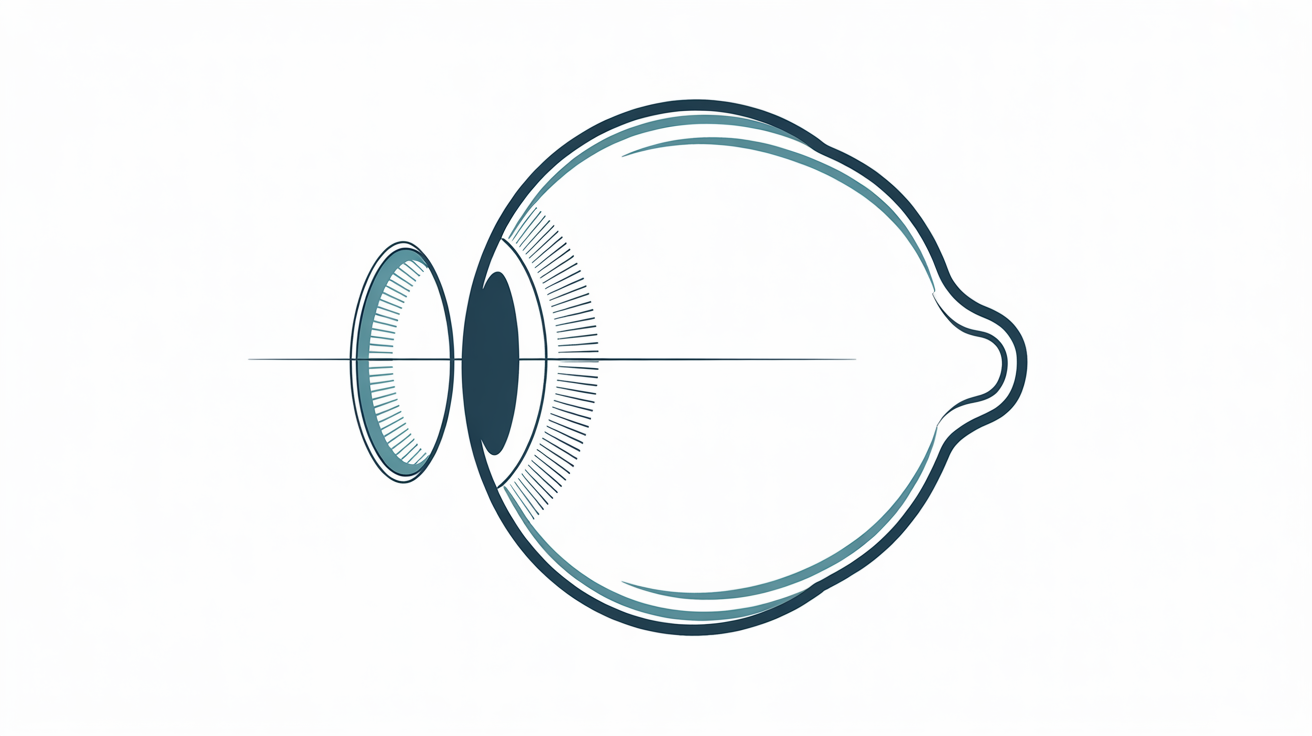
According to LensWorld, Contact Lens Base Curve Diameter Explained (24 July 2024), the base curve is the curvature of the back surface of the lens, while diameter is the width. Vision Source Rio, What is the Base Curve of a Contact Lens (17 December 2024) states the same predicate: the measured curvature of the back surface, designed to align with the eye’s natural shape. ContactsDirect states that the eye doctor measures corneal shape to determine how curved the back of the lenses should be.
Lenstore, What is Base Curve and Diameter (13 November 2025) describes base curve as how curved the contact lens is, designed to match the natural curvature of the cornea — the clear front surface of the eye. Feel Good Contacts (1 July 2024) states that base curve is determined by the actual shape of the eye and produces the lens fitting, together with diameter.
Base curve is therefore a fit attribute of contact lens parameters, not a vertex or spherical-equivalent output. Power conversion and base curve selection are separate steps on the fitting path.
How is base curve measured and labeled?
Base curve is labeled in millimeters as BC on the order and the pack.
According to Lenstore, you find the measurement on three labeled surfaces:
- The contact lens box
- The foil blister pack
- The contact lens prescription
Lenstore lists the abbreviation BC and also BOZR for base curve. 1-800 Contacts, What Does Base Curve Mean for Contact Lenses (18 June 2024) states that BC and DIA are usually visible on the outside of the box, and gives a label example of BC: 8.7 DIA: 14 as a base curve of 8.7 mm with a diameter of 14 mm. That pair is a packaging example from that page, not a universal ordered combination.
Enter the printed BC exactly as prescribed for that brand and design. Do not substitute another brand’s 8.7 mm as if the number were a shared standard.
What typical millimeter ranges appear on soft contact lenses?
The following table lists soft-lens base curve ranges as stated by published sources, not a blended “normal” value.
| Source | Stated soft base curve range |
|---|---|
| Lenstore, What is Base Curve and Diameter | Typically 8.3 mm–9.0 mm |
| EyesOnEyeCare cheat sheet, 11 August 2023 | Standard-range lenses 8.3 to 8.8 |
| 1-800 Contacts, What Does Base Curve Mean for Contact Lenses | Typically between 8.3 and 9 |
| LensWorld, Contact Lens Base Curve Diameter Explained | Typically 8–10 mm |
Lenstore, EyesOnEyeCare, and 1-800 Contacts overlap on the 8.3 mm neighborhood for the steep end of everyday soft lenses. LensWorld’s 8–10 mm band is wider. Vision Source Rio and BellaLense, Contact Lens Sizes Guide also state ranges from 8.0 to 10.0 mm on their consumer pages; treat those as additional retailer/clinic copy, not a reason to collapse the table into one average.
There is no single millimeter that this page will call “the” average base curve. These attributed ranges plus an on-eye trial answer what a typical or “normal” BC looks like. This page does not have a mode from an ECP dataset.
A contact lens base curve chart on this URL is that range table. It is not a manufacturer SKU grid and not the GPLI, Conversion Charts diopters-to-radius chart used for GP lenses.
Does a higher base curve number mean a flatter lens?
A higher base curve number in millimeters is a flatter lens; a lower number is a steeper lens.
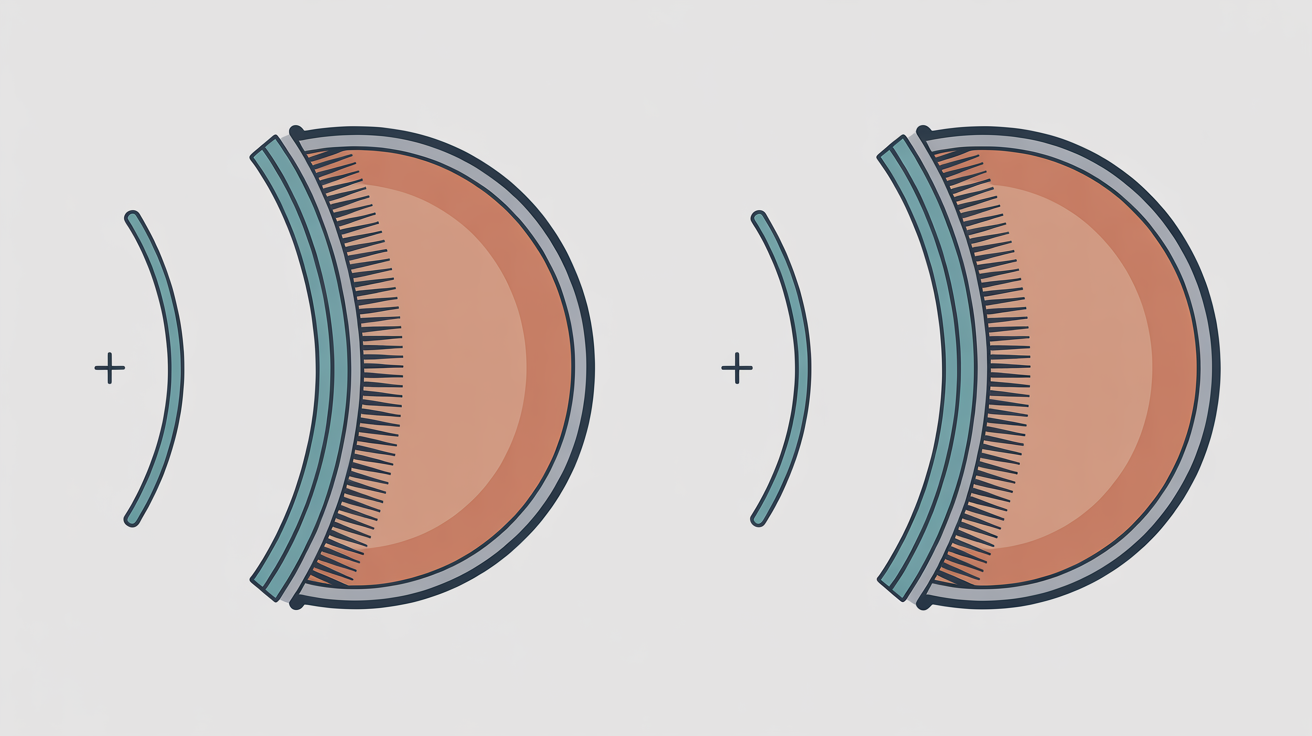
Lenstore states that mapping directly. LensWorld states that a higher base curve measurement corresponds to a flatter cornea and a lower reading to a steeper cornea. Vision Source Rio states that a lower number means a steeper curve and a higher number a flatter lens. BellaLense states the same polarity: steep cornea, lower BC number; flatter cornea, higher BC number.
1-800 Contacts writes the opposite polarity (“the higher the number, the steeper the lens”). This page follows Lenstore, LensWorld, Vision Source Rio, and BellaLense. Do not invert steeper and flatter when you read a consumer article that disagrees.
How do eye-care practitioners determine base curve?
Eye-care practitioners determine base curve with corneal measurements and a trial lens, not with a glasses prescription and not at home.
According to Pinnacle Eyecare (12 September 2025), a keratometer measures the cornea’s surface and helps determine base curve and diameter as part of a comfortable fit. ContactsDirect states that the doctor measures corneal shape to set BC. Vision Source Rio describes mapping the cornea, including with a corneal topographer, during a comprehensive exam. Lenstore states that the optometrist determines base curve and diameter during a contact lens fitting by assessing how the lens moves, centres, and feels on the eye. ContactsDirect adds that the fitter tries several lenses to determine brand, base curve, and power together.
EyesOnEyeCare (Elizabeth Davis, OD, FAAO, 11 August 2023) publishes empirical soft-lens starting bands from flat K:
| Flat K | EyesOnEyeCare starting BC band |
|---|---|
| >45.00 D | Steeper base curve (8.3, 8.4) |
| 41.00 D to 45.00 D | Median base curve (8.5 to 8.7) |
| <41.00 D | Flatter base curve (millimeter not named on that page) |
Those bands are a starting empirical selection for standard-range soft lenses, not an ordered Rx. EyesOnEyeCare also states that changing diameter or BC between brands, or between designs within a brand, may not change the fit in a predictable fashion because of material, water content, and modulus. If the lens is well-centered, covers the limbus, and moves enough for tear exchange, many patients do well in the limited BC and diameter choices each company actually makes.
Do not determine base curve at home. Queries such as how to determine base curve for contacts at home are out of clinical bounds. Keratometry and trial-lens assessment belong to a licensed fitter.
GP keratometry-to-radius math is a different entity. The GPLI, Conversion Charts include pairs such as 45.00 D → 7.50 mm. That chart is for GP radius conversion, not a soft-lens BC picker. Use RGP Contact Lens Parameters and Starting Power.
According to González-Cavada and colleagues (PMC3972800, Senofilcon A, 40 eyes, keratometry flatter than 7.80 mm), an 8.40 mm base curve scored more comfortable than 8.80 mm (mean comfort 4.39±0.5 vs 3.5±0.92, P <0.001) with no statistically significant movement difference. The authors suggest silicone hydrogel lenses may require steeper base curve selection criteria than conventional hydrogels for comfort. That result is attributed to that SiHy design and sample. It does not replace the EyesOnEyeCare flat-K bands or an on-eye trial of the lens you actually order.
Why does spectacle conversion not produce a base curve?
Spectacle conversion does not produce a base curve because a glasses Rx contains power, not corneal geometry.
According to Pinnacle Eyecare, you cannot safely or accurately convert a glasses prescription to a contact lens prescription on your own. A conversion chart cannot figure out three contact-lens measurements:
- Base curve
- Diameter
- Lens brand and material
Feel Good Contacts states that you cannot directly convert a glasses prescription to a contact lens prescription, and lists base curve and diameter among contact-only specifications. ODReference’s conversion tool describes a starting soft-lens power that still requires on-eye evaluation and lens-specific decisions such as base curve, diameter, and material.
The Contact Lens Conversion Calculator converts spectacle prescription to contact lens parameters at the corneal plane: vertex-compensated starting power, optional spherical equivalent, rounding. Calculate starting sphere there. Fit base curve here, on eye.
Are two nearby base curve numbers interchangeable?
Two nearby base curve numbers are not interchangeable without an on-eye confirmation for that brand and design.
Lenstore states that even a fractional difference can affect how the lens sits, and that even if two lenses share the same base curve number, material, thickness, and design may differ. EyesOnEyeCare cites a lens-parameter study: changing diameter or BC between brands may not change fit predictably.
Printed numbers such as 8.3 mm, 8.5 mm, and 9.0 mm are not catalog substitutes. 8.3 mm sits in the EyesOnEyeCare steeper band. 8.5 to 8.7 mm sits in the median band. 9.0 mm appears in Lenstore’s typical 8.3–9.0 mm window and on some manufacturer pairs in retailer tables. None of those printed numbers is a substitute for another without a fitting. This page does not rank SKU comparisons and does not list which brand “has” 8.3.
Sagittal depth is the geometric reason BC and diameter must be read together: both change how the lens vaults the cornea. Fit diameter with the Diameter of Contact Lenses explainer, then return to the ordered sphere.
When should base curve change instead of power on a toric lens?
Unstable toric rotation is addressed by changing base curve, diameter, or design before optical compensation.
According to ODReference’s cross-cylinder page, chasing power on a lens that will not stabilize is a moving target. Cross-cylinder refinement assumes the replacement lens rotates the same way as the trial. Start geometry on this page, then diameter or a different stabilization design. Calculate starting SPH, CYL, and AX on the Toric Contact Lens Calculator. You still fit a starting toric or multifocal contact lens on eye.
Starting contact lens parameters still require on-eye fit
Starting contact lens parameters still require on-eye fit because converted power plus a printed BC is not a finished prescription.
Pinnacle lists blur, strain, dryness, and discomfort among risks of an ill-fitting lens. Lenstore lists discomfort, redness, blurred vision, and reduced oxygen flow when BC is wrong. Vision Source Rio describes a tight lens as constant pressure and a loose lens as slip and blur. Those are reasons to verify on the chair, not to order a neighboring BC from a shopping listing.
Patient aside (Grade 8–9)
The number on a glasses Rx is not your contact lens base curve. An eye-care practitioner measures the eye, tries a lens, and writes BC with diameter and power. Do not swap 8.5 for 9.0 because a box was in stock.
Read Starting Contact Lens Parameters Are Not a Prescription for the bound that applies across this site. Convert spectacle prescription to contact lens parameters for power. Fit base curve on eye. Verify power with over-refraction after the trial lens. Contact lens parameters at the corneal plane stay unfinished until that sequence is done.
Sources
Clinical claims on this page are attributed to the publications below.
- Lenstore, What is Base Curve and Diameter— back-surface curvature; BC/BOZR labels on box, blister, and prescription; typical soft BC 8.3–9.0 mm; higher mm = flatter; most soft diameters fixed per brand.
- LensWorld, Contact Lens Base Curve Diameter Explained— back-surface curvature versus diameter as width; typical soft BC 8–10 mm; higher number = flatter cornea.
- 1-800 Contacts, What Does Base Curve Mean for Contact Lenses— BC and DIA on the box; example BC: 8.7 DIA: 14; typical BC between 8.3 and 9.
- Vision Source Rio, What is the Base Curve of a Contact Lens— measured back-surface curvature; lower number = steeper; tight versus loose fit.
- BellaLense, Contact Lens Sizes Guide— steep cornea, lower BC number; flatter cornea, higher BC number; consumer range 8.0 to 10.0 mm.
- GPLI, Conversion Charts— 45.00 D → 7.50 mm for GP radius conversion, not a soft-lens BC picker.