What is the spherical equivalent of a prescription?
The spherical equivalent is the single spherical power that sits midway between the two principal meridians of a spherocylindrical refraction.
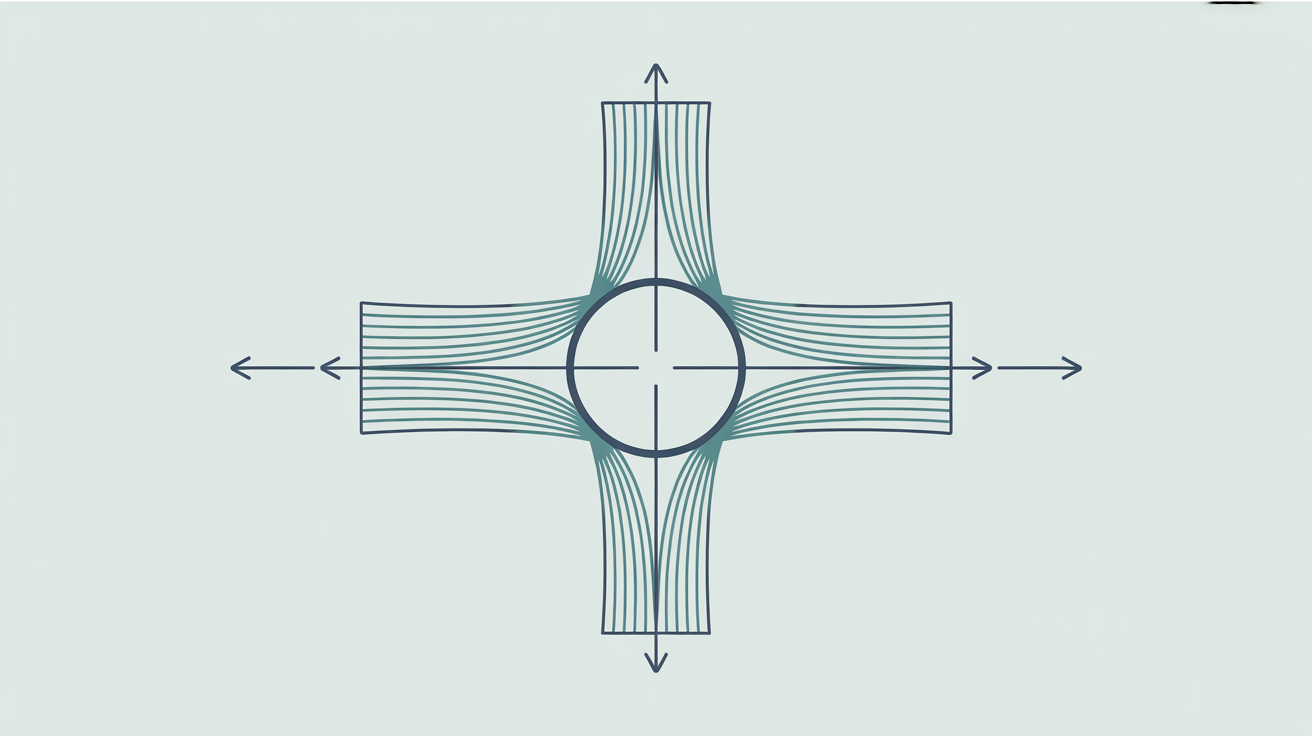
A spherocylindrical lens has two principal meridians 90 degrees apart: the sphere meridian, and the sphere-plus-cylinder meridian. Average them and you get one sphere with no cylinder and no axis. According to the ODReference Contact Lens Conversion Calculator, that average places the circle of least confusion near the retina, which is why a spherical soft lens over low, regular astigmatism still gives usable vision. Enaholo, Musa and Zeppieri give the same identity as SE = S + C/2 in the StatPearls chapter The Spherical Equivalent, and name ordering a soft contact lens for a patient with very low or no manifest subjective astigmatism as one of its indications. The same arithmetic appears in intraocular-lens planning and in myopia research, where refractions are reported in spherical-equivalent diopters. This page computes it for one job only: a starting contact lens power at the corneal plane.
How do you calculate spherical equivalent?
Calculate spherical equivalent as SE = Sphere + (Cylinder ÷ 2), taken after vertex compensation and rounded to the nearest 0.25 D.
Formula
SE = Sphere + (Cylinder ÷ 2)
Vertex first = Fc = Fs ÷ (1 − d × Fs), d in meters, by meridian at or above about ±4.00 D
Ordered power = nearest 0.25 D step
The following three steps calculate a starting spherical power.
- Convert each principal meridian to the corneal plane at the stated vertex distance when it reaches the ±4.00 D gate.
- Add half the reconstructed cylinder to the reconstructed sphere.
- Round the result to the nearest 0.25 D manufacturing step.
A worked example below the gate: −2.00 −1.00 × 180 has meridians −2.00 and −3.00. Neither reaches ±4.00 D, so nothing is vertexed. SE = −2.00 + (−1.00 ÷ 2) = −2.50, which is already a 0.25 D step. Cylinder notation is dropped because the lens being ordered has no cylinder to place — there is no axis in a spherical equivalent.
Spherical equivalent chart: worked examples at 12 mm
The following table recomputes each row from the formulas above at a 12 mm vertex distance. It is not copied from a manufacturer grid, and it does not name a lens.
| Spectacle Rx | Meridians | SE at spectacle plane | SE after 12 mm vertex | Ordered (0.25 D) |
|---|---|---|---|---|
| −2.00 −1.00 × 180 | −2.00 / −3.00 | −2.50 | −2.5000 | −2.50 |
| −5.00 −1.50 × 180 | −5.00 / −6.50 | −5.75 | −5.3733 | −5.25 |
| −8.00 −1.00 × 180 | −8.00 / −9.00 | −8.50 | −7.7110 | −7.75 |
| −10.00 −2.00 × 180 | −10.00 / −12.00 | −11.00 | −9.7090 | −9.75 |
| +4.50 +1.00 × 090 | +4.50 / +5.50 | +5.00 | +5.3228 | +5.25 |
| −1.00 −3.75 × 090 | −1.00 / −4.75 | −2.875 | −2.7469 | −2.75 |
Clinical takeaway
Vertex the meridians, average them, then round. The last row is in the table as a warning, not as a recommendation: a 3.75 D cylinder is a toric decision, and the spherical equivalent only tells you how much you would be giving up.
Why is spherical equivalent applied after vertex compensation?
Spherical equivalent is applied after vertex compensation because Fc = Fs ÷ (1 − d × Fs) is not linear, so averaging first can order a different power.
Take −5.00 −1.50 × 180 at 12 mm. Done in the correct order, the meridians −5.00 and −6.50 compensate to −4.7170 and −6.0297, the reconstructed pair is −4.72 −1.31, and the spherical equivalent is −5.3733, which orders −5.25. Done in the wrong order, the spectacle-plane average is −5.75, compensating that single number gives −5.3789, and it orders −5.50.
The two unrounded numbers differ by less than 0.01 D. They still land on opposite sides of a 0.25 D rounding boundary, which is exactly how a quarter-diopter appears and disappears without anyone noticing. According to ODReference, spherical equivalent is applied only after vertex compensation is applied where needed. Isolate that step on the Contact Lens Vertex Calculator and Distance Chart, or read why the planes differ in Vertex Distance of Contact Lenses.
When is a spherical equivalent appropriate instead of a toric lens?
A spherical equivalent is appropriate when you intend to fit a spherical lens over low, regular astigmatism and accept the residual cylinder.
According to the ODReference Contact Lens Conversion Calculator, spherical equivalent in soft lens prescribing is a clinical compromise, not a substitute for toric correction when full cylinder correction is needed. It is applied only when you indicate that a spherical lens is being considered. The following three findings send the decision to a toric lens instead.
- Cylinder that the patient is sensitive to, where blur from residual astigmatism is not accepted
- Higher cylinder, where averaging gives away more than the patient can tolerate
- Irregular astigmatism, where neither a spherical equivalent nor a standard soft toric is the right design family
Bella Lense's conversion guide states the common dispensing convention: cylinder of 0.75 D or less can often be accommodated in a standard spherical lens using a spherical equivalent, while cylinder above 0.75 D typically requires a toric lens. This calculator flags that number and does not enforce it. A cutoff is a fitting judgment made by a licensed practitioner on a specific patient, so the tool returns the arithmetic and reports what stays uncorrected. Calculate starting sphere, cylinder, and axis on the Toric Contact Lens Calculator when cylinder correction is indicated.
What does a spherical equivalent leave uncorrected?
A spherical equivalent leaves the whole cylinder uncorrected; each principal meridian stays half the cylinder away from the focus you ordered.
The astigmatism does not go anywhere. Averaging moves the focus to the middle of it. For −5.00 −1.50 × 180 at 12 mm, the reconstructed cylinder is 1.31 D, so each principal meridian sits about 0.66 D from the spherical equivalent. For −1.00 −3.75 × 090, 3.49 D of cylinder is still on the eye after the average, and the result panel says so.
That number is also a chair-side teaching tool. According to the Eyes On Eyecare contact lens cheat sheet, when a refraction such as −1.00 −3.75 × 090 exceeds a standard toric fitting range, you can show the patient the difference between full correction and a partial spherical equivalent — −1.50 −2.75 × 090 — so they understand why an extended-range toric is being recommended. The half-cylinder arithmetic is the same one this page runs; the conclusion there is more cylinder, not less.
Patient aside (not a substitute for a fitting)
A spherical equivalent is one averaged number that stands in for a prescription with astigmatism. It can work well when the astigmatism is small. It does not correct astigmatism, and it isn't a lens you can order for yourself. Your practitioner decides whether a spherical or toric lens is fitted.
Does plus-cylinder or minus-cylinder notation change the spherical equivalent?
Cylinder notation does not change the spherical equivalent, because both writings describe the same two principal meridians.
Enter +4.50 +1.00 × 090 and the meridians are +4.50 and +5.50. Transpose it to +5.50 −1.00 × 180 and the meridians are still +5.50 and +4.50. The average is +5.00 at the spectacle plane and +5.3228 after a 12 mm vertex either way, ordering +5.25 from both writings. A spherical equivalent calculator that returns different numbers for plus and minus cylinder has a transposition error, not an optics disagreement. Standardize the written format first on the Plus and Minus Cylinder Transposition Calculator when the chart, the order, and the referral disagree.
Where does spherical equivalent sit in the full spectacle-to-contact conversion?
Spherical equivalent is the third step of a conversion: standardize notation, vertex the meridians, average to a spherical equivalent, then round to 0.25 D.
According to the ODReference conversion workflow, a common soft lens sequence is to enter the refraction as written, allow vertex compensation beyond about ±4.00 D, choose spherical versus toric — using spherical equivalent only when residual cylinder is intentionally accepted — round to available steps, then confirm fit, comfort, and over-refraction on eye. The following four steps place this URL inside that sequence.
- Standardize plus-cylinder or minus-cylinder notation so sphere, cylinder, and axis agree across the chart and the order.
- Convert each principal meridian to the corneal plane at the stated vertex distance.
- Calculate the spherical equivalent here when a spherical lens is intended, and round to 0.25 D.
- Fit the trial lens, then verify residual power with an over-refraction.
This page owns the spherical equivalent computation on its own — one refraction in, one averaged starting sphere out, with the residual cylinder stated. The whole conversion, including the toric branch, lives on the Contact Lens Conversion Calculator. Use that tool when the question is the ordered lens rather than the average, and use the Contact Lens Conversion Chart when you want the lookup instead of the arithmetic. Every formula and constant on this site is disclosed on How We Calculate.
Spherical equivalent calculator questions
What is the spherical equivalent formula?
The spherical equivalent formula is SE = Sphere + (Cylinder ÷ 2), which is the same as averaging the two principal meridians.
Half of the cylinder is added algebraically, so the sign of the cylinder carries into the result.
Is spherical equivalent the same as average power?
Spherical equivalent is the mean of the two principal meridian powers, so yes, it is the average power of the spherocylindrical lens.
The two descriptions are one calculation written two ways.
Should spherical equivalent be calculated before or after vertex compensation?
Spherical equivalent is calculated after vertex compensation, on the meridians already converted to the corneal plane.
Averaging first and vertexing second can order a different 0.25 D step.
Does a spherical equivalent keep the axis?
A spherical equivalent has no axis, because a spherical lens has no cylinder to orient.
Record the original refraction alongside it so the cylinder given up stays documented.
Can a spherical equivalent replace an indicated toric contact lens?
A spherical equivalent cannot replace indicated toric correction; it is a compromise that accepts residual cylinder.
Calculate a starting toric power when cylinder correction is indicated, and verify it on eye.
Does spherical equivalent apply to a contact lens over-refraction?
Spherical equivalent applies to a spherocylindrical over-refraction the same way it applies to a spectacle refraction.
Combine the trial lens and the over-refraction on the Over-Refraction Calculator for Contact Lens Parameters before averaging anything.
A spherical equivalent is a starting power, not a prescription
Not a Rx
Not a prescription / on-eye next step
A spherical equivalent is not a contact lens prescription and not a final power.
Starting parameters still require fit, comfort, and verification on eye. Base curve, diameter, and material are not produced by averaging power — Base Curve of Contact Lenses and Diameter of Contact Lenses cover those. Independent professional judgment decides whether a spherical or toric lens is ordered, and a licensed practitioner verifies it after the trial lens. Read the bound on Starting Contact Lens Parameters Are Not a Prescription. Convert spectacle prescription to contact lens parameters after this step; contact lens parameters at the corneal plane are the conversion output, not the average.
Sources
- Enaholo ES, Musa MJ, Zeppieri M. The Spherical Equivalent. StatPearls, NCBI Bookshelf — SE = S + C/2 stated as the identity itself, with ordering a soft contact lens for a patient with very low or no manifest subjective astigmatism named as an indication, and reduced visual acuity relative to a toric correction named as its cost. Cited for the formula and the indication; the vertex ordering and the 0.25 D step below are this site's, not that chapter's.
- ODReference, Contact Lens Conversion Calculator — SE = Sphere + (Cylinder ÷ 2); spherical equivalent as a clinical compromise placing the circle of least confusion near the retina; applied only after vertex compensation and only when a spherical lens is intended; the ±4.00 D vertex gate; the five-step soft lens workflow.
- Eyes On Eyecare, The Contact Lens Cheat Sheet — showing a patient −1.00 −3.75 × 090 against the partial spherical equivalent −1.50 −2.75 × 090 when cylinder exceeds a standard toric fitting range.
- Bella Lense, Glasses to Contacts Conversion Guide — the 0.75 D dispensing convention: cylinder at or below 0.75 D often accommodated with a spherical equivalent, above 0.75 D typically toric. Recorded as a convention, not applied as a gate.
- Contact Lens Calculator (contactlenscalculator.net) — independent conversion tool that bundles vertex and spherical equivalent, named as an alternative.
Published Last updated Report a correction