What do OD and OS stand for on a contact lens prescription?
OD is oculus dexter, Latin for right eye. OS is oculus sinister, Latin for left eye.
Three independent sources state the same pair. Acuvue, How to read contact lens prescriptions (medically reviewed by Dr. Giovanna Olivares, OD, FAAO; published 21 August 2024, updated 17 March 2026) gives O.D. as short for oculus dexter, Latin for “right eye”, and O.S. as short for oculus sinister, Latin for “left eye”. The American Academy of Ophthalmology (Robert F. Melendez, MD, 9 October 2008) lists the same two Latin terms. 1-800 Contacts (14 December 2023) adds the part that matters operationally: the numbers next to OD pertain specifically to the right eye, and the numbers next to OS are all about the left.
A designator is not a value. It has no unit, no sign and no diopters, and nothing on the page is calculated from it. It is a label, and its whole job is to bind a set of numbers to one eye. The same field is written OD and OS, O.D. and O.S., or spelled out as right and left — one field, several house styles.
Oculus dexter and oculus sinister are the long forms of exactly these two abbreviations; there is nothing further to translate. One ambiguity is worth a sentence and no more: OD also abbreviates Doctor of Optometry, a practitioner credential that follows a name rather than sitting beside a power — on a contact lens prescription, OD is the eye.
Which eye is OD, and which eye is OS?
OD is the wearer’s own right eye and OS the wearer’s own left — not the eye on your right as you look at the person.
That distinction is the one people actually get wrong. Facing someone, their right eye appears on your left. A prescription is written from the wearer’s point of view, so the OD row belongs to the eye that sits on the reader’s left in the diagram below, and the OS row to the eye on the reader’s right.
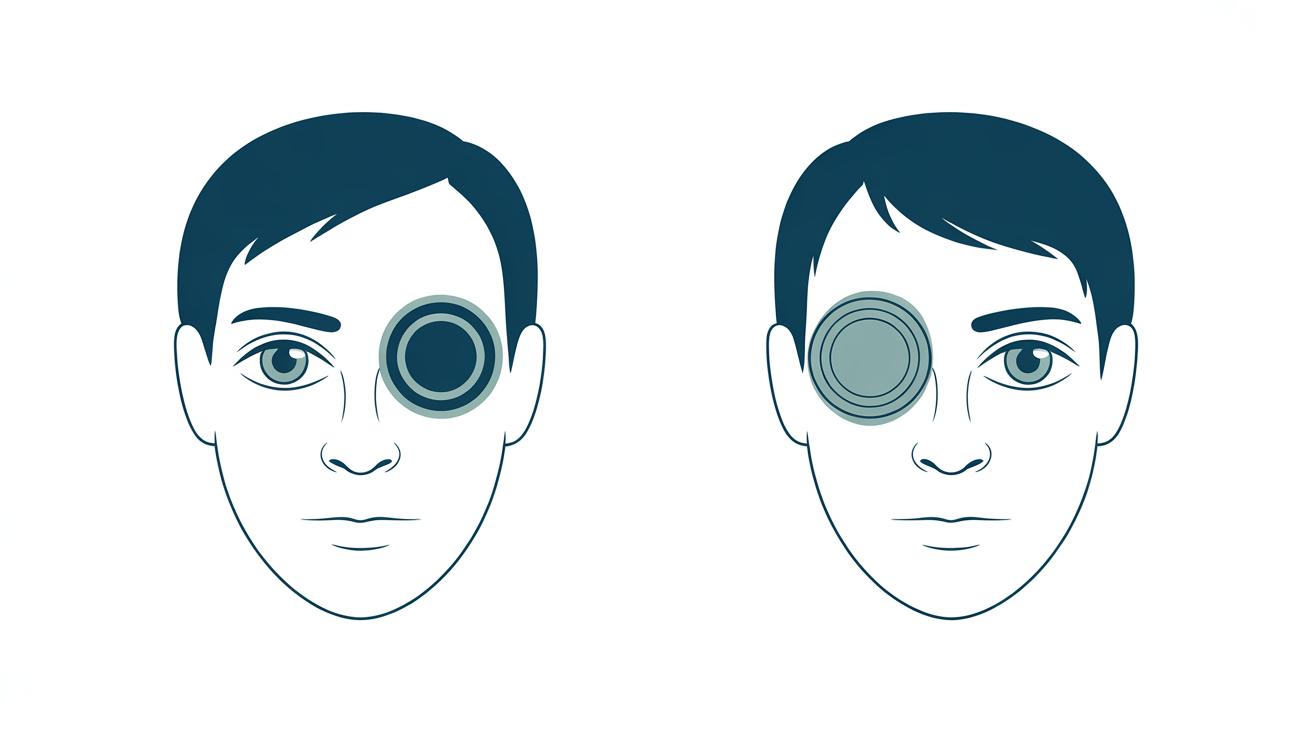
Row order is a layout convention, not a rule. Most forms print the OD row above the OS row, and reading position instead of the designator works until it does not — a re-typed order form, a spreadsheet sorted by another column, a photograph cropped to one row. Read the designator every time, and if a document carries a single row, it should still say which eye that row is for.
Nothing in the numbers tells you which eye they belong to. A −3.00 D row is a plausible right eye and an equally plausible left eye. The designator is the only thing carrying that information from the chair to the order, which is why the rest of this page is about not losing it.
What does OU mean, and when is it printed?
OU means both eyes.
The American Academy of Ophthalmology gives the Latin as oculi uterque and unitas, and records something a one-line glossary usually leaves out: OU carries two clinical senses — both eyes together and both eyes separately — and only the context around it decides which one is meant.
On a contact lens prescription OU appears where a single value covers both eyes: one instruction, one design, one wearing schedule. Its absence is not an error. Most contact lens prescriptions print two rows and never need it, because a row per eye is strictly more specific than a shared line, and specificity is the whole point of the document.
That is also the practical rule for OU. Because the abbreviation is less specific than the pair it replaces, expand it rather than carry it: an OU line that has to become two ordered lenses is a line someone will have to interpret twice.
Why do the two eyes carry two separate parameter sets?
Because each eye is refracted and fitted separately. The two rows are two independent results, not one result printed twice.
Under 16 CFR § 315.2 a contact lens prescription carries the power, the base curve or appropriate designation, and the diameter when appropriate, for the prescribed lens — and a lens is prescribed for an eye. Base curve and diameter come from the shape of that cornea. Power comes from that eye’s refraction. Neither is derivable from the other side of the face.
The optical half of that has a consequence most explanations of OD and OS skip. Moving a spectacle power to the corneal plane is not a linear shift, and this site applies it one eye at a time, at a default vertex of 12 mm, on any meridian at or beyond ±4.00 D, rounded to the 0.25 D step lenses are made in. Two eyes therefore do not move by the same amount:
| Row | Spectacle sphere | ±4.00 D gate | Corneal plane | Ordered at 0.25 D | Shift |
|---|---|---|---|---|---|
| OD | −8.00 D | met | −7.2993 D | −7.25 D | +0.75 D |
| OS | −5.00 D | met | −4.7170 D | −4.75 D | +0.25 D |
3.00 D separate the two eyes on the spectacle plane. 2.50 D separate the ordered lenses. The gap between someone’s eyes is itself a spectacle-plane quantity, and it does not survive the move to the cornea unchanged.
The gate makes it starker still. A pair written OD −7.00 / OS −3.50 has one row past the ±4.00 D threshold and one row below it: OD is compensated and ordered at −6.50 D, while OS is ordered at −3.50 D exactly as written. One eye moved, the other did not, on one document.
None of that arithmetic happens here. Convert on the Contact Lens Conversion Calculator, which takes one eye at a time, and read why the plane change happens at all on vertex-compensated contact lens power. The non-optical parameters are not converted at all: Base Curve of Contact Lenses and Diameter of Contact Lenses are fitted to the eye in front of the fitter. A multifocal prescription may additionally mark the two eyes differently — that field is covered on add designation, and the starting near add on the Multifocal Contact Lens Calculator.
What happens when OD and OS are swapped?
A swapped pair is silent. Both rows stay individually plausible, so nothing in the numbers flags the error.
That is what makes it a transcription problem rather than an arithmetic one. Two rows retyped into an order form, copied into a chart, or read back over a phone can arrive complete, internally consistent and reversed, and every downstream check that only asks whether a power is orderable will pass.
The abbreviation pair has a documented error rate in the wider clinical record. The Institute for Safe Medication Practices lists OD, OS, OU — intended to mean right eye, left eye, each eye — as mistaken as AD, AS, AU (right ear, left ear, each ear), with the best practice given as “use right eye, left eye, or each eye”. The same list records the reverse collisions: o.d. or OD intended as once daily and mistaken as right eye, “leading to oral liquid medications administered in the eye”, and per os, whose os is mistaken as left eye.
Read that scope precisely. The ISMP list governs how medication information is communicated; it is not a labelling standard for contact lens prescriptions, and OD and OS remain the standard designators on one. What it demonstrates is the failure mode: these two letters are exchanged often enough, by trained people, to sit on a national safety list.
Two rows are less forgiving than most. A toric row carries an axis, which is an orientation measured on one specific eye — swap the rows and the correction is being placed by a map of the other eye. A multifocal pair may be set differently by design. Rotation and axis on a toric are handled on the Toric Contact Lens Calculator.
There is nothing clever to do about a suspected swap. Check the designator on the sheet against the designator on the box; if they disagree, ask the practice that wrote the prescription rather than reconciling it yourself. Whether the power actually delivered is the right one for that eye is an over-refraction finding, taken one eye at a time.
Where do OD and OS sit among the other printed fields?
They are the first column of a grid with one row per eye.
§ 315.2 enumerates what a contact lens prescription contains — the patient’s name, the examination date, the issue and expiration dates, the prescriber’s details, the power, the base curve or appropriate designation, and the diameter when appropriate — and it does not name an eye designator among those items. The designation is how a practice’s form labels the rows that everything else is printed on, which is why it is universal without being enumerated.
A glasses prescription uses OD and OS as well, and that is where the similarity stops: 1-800 Contacts states plainly that a contact lens prescription is not the same document and that one cannot be used to buy the other. Whether a spectacle Rx can be reused at all is answered on Starting Contact Lens Parameters Are Not a Prescription.
Every other printed field, including how long the document stays valid, is read end to end on How to Read a Contact Lens Prescription. For the individual fields: is power the same as sphere, what CYL means, and what axis means.
Starting contact lens parameters still require on-eye fit
A designator is notation; everything printed beside it is a fitted value.
§ 315.2 defines a contact lens fitting as the process that begins after an initial eye examination and ends when a successful fit has been achieved, and it defines the issue date as the day the patient receives the prescription at the completion of that fitting. Both rows on the sheet are downstream of that. A converted power is upstream of all of it — a starting parameter for one eye, offered so a fitter has somewhere to begin.
Patient aside (Grade 8–9)
OD is your right eye. OS is your left. The two lines on your prescription are not interchangeable, because each one was worked out for one eye. If you are ever unsure which lens is which, do not guess and wear one to find out — check the box against your prescription, and ask the practice that wrote it if the two do not match.
Read Starting Contact Lens Parameters Are Not a Prescription for the bound that applies across this site. Convert each eye’s spectacle power separately on the Contact Lens Conversion Calculator. Fit base curve and diameter on eye. Verify the result with an over-refraction, one eye at a time. Contact lens parameters at the corneal plane stay unfinished until that sequence is done for both.
Sources
Clinical and regulatory claims on this page are attributed to the publications below.
- Acuvue, How to read contact lens prescriptions(medically reviewed by Dr. Giovanna Olivares, OD, FAAO; published 21 August 2024, updated 17 March 2026) — O.D. as short for oculus dexter, Latin for “right eye”; O.S. as short for oculus sinister, Latin for “left eye”; a contact lens prescription as tailored to one person’s eyes.
- American Academy of Ophthalmology, When abbreviations mean several things: learning your Latin(Robert F. Melendez, MD, 9 October 2008) — OD Oculus dexter, OS Oculus sinister, OU Oculi uterque and unitas; OU carrying both the “both eyes together” and “both eyes separately” senses depending on context.
- 1-800 Contacts, Decoding the eye lingo: understanding OD vs OS in contact lens prescriptions(1-800 Contacts Team, 14 December 2023) — OD (Oculus Dexter) as “Right Eye”, with the adjacent numbers pertaining specifically to that eye’s prescription; OS (Oculus Sinister) as “Left Eye”; a contact lens prescription as a different document from a glasses prescription, neither usable to buy the other.
- Institute for Safe Medication Practices, List of Error-Prone Abbreviations, Symbols, and Dose Designations(2024) — OD, OS, OU intended as right eye, left eye, each eye and mistaken as AD, AS, AU (right ear, left ear, each ear), best practice “use right eye, left eye, or each eye”; o.d. or OD intended as once daily and mistaken as right eye, leading to oral liquid medications administered in the eye; per os, whose os is mistaken as left eye. Scope: communication of medication information, not contact lens labelling.
- 16 CFR Part 315, Contact Lens Rule— § 315.2’s enumerated contents of a contact lens prescription, including the power, the base curve or appropriate designation and the diameter when appropriate, for the prescribed lens; contact lens fitting as the process ending when a successful fit has been achieved; the issue date as the day the patient receives a copy at the completion of that fitting. Retrieved from the eCFR, 14 August 2026.
- src/lib/conversion.ts —
DEFAULT_VERTEX_MM12 mm,VERTEX_GATE_D±4.00 D,POWER_STEP_D0.25 D, andconvertEye()as a per-eye function. Every figure in the two-row table above was computed by that module at build time; no constant is re-typed on this page.
Published Last updated Report a correction