What is the lacrimal lens?
The lacrimal lens is the post-lens tear film treated as an optical element — the same structure clinicians also call the tear lens or the fluid lens.
According to Ento Key, Rigid Contact Lenses: Basics (Stein, Slatt, Stein and Freeman, Fitting Guide for Rigid and Soft Contact Lenses), a rigid lens does not drape onto the cornea; the fluid interface between the lens and the cornea fills out irregularities in the anterior corneal contour, so the fluid may be considered a forward extension of the cornea. That chapter states the consequence directly: if the radius of the back surface of the lens is the same as the front surface of the cornea, the fluid lens is zero, and a change in the contact lens base curve alters the fluid lens power.
Three names, one structure. Lacrimal lens is the term that travels with the optics in teaching material and in laboratory fitting guides; tear lens is the shorter chairside form; fluid lens is the older usage. This page uses them interchangeably in that optical sense. It has nothing to do with a torn or split lens, which is a handling problem, not an optical one.
How is tear lens power calculated?
Tear lens power is the base curve in diopters minus the flat K in diopters, and nothing else.
According to the ODReference, RGP Lens Calculator, the space between the back surface of the lens and the anterior cornea fills with tears and forms a tear lens with real refractive power, and that power is approximately base curve (D) − flat K (D). Both values have to be in the same unit first. A K reading or a base curve quoted in millimeters of radius converts through D = 337.5 ÷ r, the standardized keratometric relationship the RGP Contact Lens Power Calculator applies before the subtraction. A verified radius of 8.20 mm reads as 41.16 D through that relationship.
Worked example, in the ODReference form: flat K 44.00 D, selected base curve 45.00 D — about 7.50 mm of radius — gives a tear lens of +1.00 D. The lens is steeper than the cornea, so the fluid layer is thicker in the centre than at its edges: a plus lens. Whatever plus the tear layer supplies, the ordered lens has to give back, which is why that +1.00 D appears as a minus adjustment on the order.
Why does steeper than K give plus and flatter than K give minus?
Because the shape of the fluid layer follows the mismatch: a steeper lens leaves a fluid layer that is thick centrally and thin at its edges, which is a plus lens, and a flatter lens leaves the reverse.
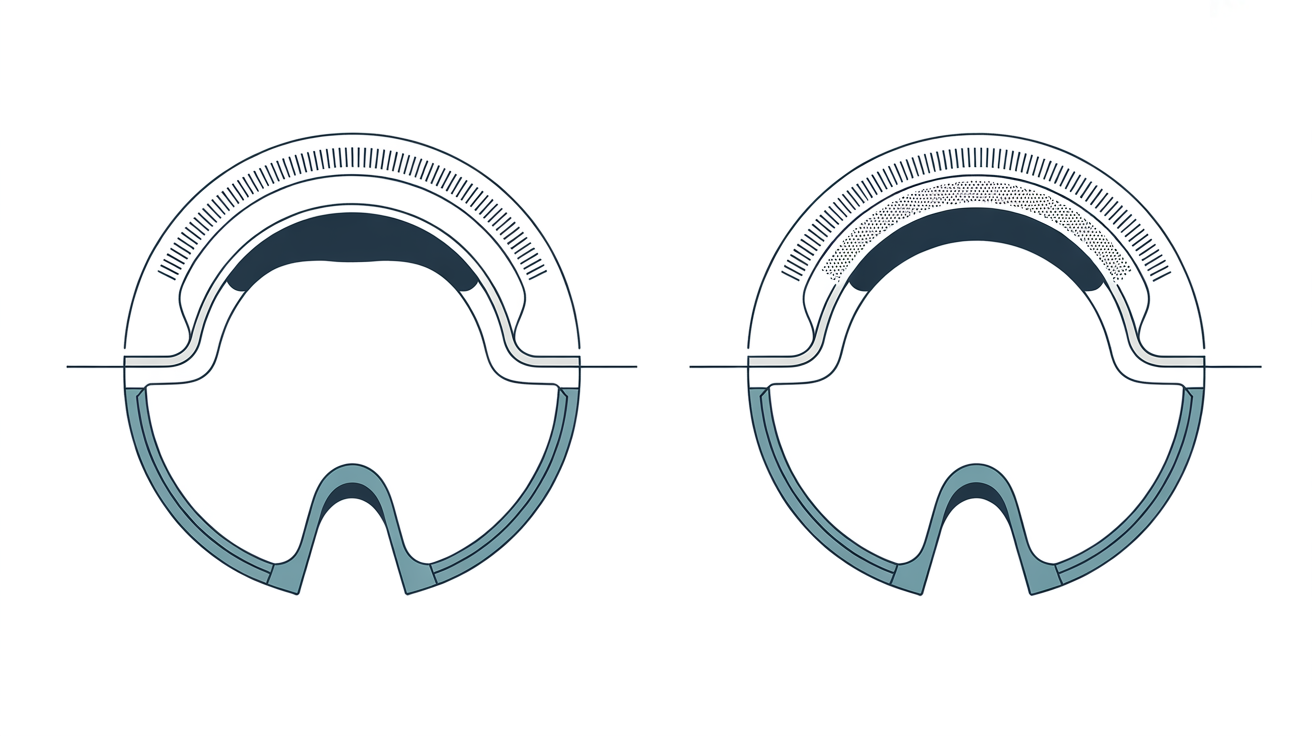
According to Cybersight (Orbis International), Rigid Gas Permeable Lens Assessment and Fitting (Jason Chin, OD, FAAO, New England College of Optometry), a steep base curve over a flatter cornea gives a lacrimal lens with plus power, and a flat base curve over a steeper cornea gives one with minus power. Draw the cross-section and the geometry is the whole explanation: the space between two curves of different radius is convex in one case and concave in the other.
| Base curve against flat K | Shape of the fluid layer | Tear lens acts as |
|---|---|---|
| Steeper (higher in D, smaller in mm) | Thicker centrally, thinner at the edges | Plus |
| On K | Even | About zero, before residual cylinder |
| Flatter (lower in D, larger in mm) | Thinner centrally, thicker at the edges | Minus |
The mnemonics are the same statement read from the ordering side. SAM — Steeper Add Minus — and FAP — Flatter Add Plus — say that when you steepen the base curve you have added plus tear lens, so minus goes into the ordered power to compensate, and the reverse when you flatten. Cybersight gives the chairside step as approximately 0.50 D of tear-lens change for every 0.1 mm of base curve radius, and notes the same correction applies when the diameter or optic zone diameter changes, because those move the effective fitting relationship too. The ordering workflow that puts SAM and FAP into a full starting power sits on RGP Contact Lens Parameters and Starting Power.
Why does the tear lens mask corneal astigmatism?
A spherical rigid back surface over a toric cornea leaves a fluid layer that is itself toric, and that layer neutralises most of the corneal cylinder before any lens power is involved.
Ento Key’s basics chapter puts it as the fluid converting an astigmatic cornea into a spherical one, and states that when fitting rigid lenses the corneal cylinder is disregarded by the fitter because up to 3.00 D of with-the-rule corneal astigmatism can be corrected with a rigid spherical lens. Practical thresholds published for design selection are lower: this site’s calculators flag a spherical GP for review above 2.00 D of corneal cylinder, following the GPLI nomogram limit.
The masking is not free. It only holds while the back surface still aligns; past the threshold the lens decentres, the pattern goes uneven, and cylinder has to be carried by the lens rather than the tears. What happens then — back-surface toric, spherical power effect, cylindrical power effect — is on Bitoric GP Contact Lenses: Design and Power Effect. Soft toric lenses have no tear lens to do this work, which is why their cylinder is ordered on the lens and stabilised by rotation on the Toric Contact Lens Calculator.
What changes if you change the base curve after the fit?
The ordered power changes, because the tear lens you calculated belonged to the base curve you replaced.
This is the most common arithmetic slip in a GP re-order, and published fitting guides are built around preventing it. According to Contact Lens Spectrum, Putting a Bitoric Fitting Guide to the Test (Kirby Pitts, OD and colleagues, October 2001), when you alter the base curve radii you must modify the powers to compensate for induced lacrimal lens effects — their worked case is a flat meridian fitted 0.50 D flatter than K, which makes the power in that meridian 0.50 D more plus. That article names the failure mode as well: subtracting a tear lens power instead of adding it.
The order of operations that avoids it:
- Settle the geometry first — read the fluorescein pattern and change base curve, diameter, or periphery until the fitting relationship is right.
- Recompute the tear lens for the base curve you actually intend to order.
- Apply SAM or FAP to the ordered power for the change you just made.
- Measure the over-refraction through the settled lens and fold it in.
Steps one and two are read on Fluorescein Patterns and Fit Troubleshooting of GP Lenses. Step three runs as arithmetic on the RGP Contact Lens Power Calculator. Step four belongs to the Over-Refraction Calculator for Contact Lens Parameters.
When is the tear lens not the answer?
When the residual error is lenticular rather than corneal, or when the lens is flexing — neither is a tear-lens problem and neither is solved by another base curve.
The tear lens can only neutralise astigmatism that lives on the front surface of the cornea. Cylinder originating in the crystalline lens passes through it untouched and shows up in the over-refraction, where it has to be carried by the lens as a front-surface toric or by a different modality. A thin GP flexing on a toric cornea produces the same symptom from a different cause. Distinguishing them is an over-keratometry or over-topography measurement made by the fitter, not a calculation.
Read Starting Contact Lens Parameters Are Not a Prescription for the bound that applies across this site, and GP Contact Lens Design: Zones, Curves, and Edge Lift for the parameter set the base curve belongs to.
Patient aside (Grade 8–9)
A hard lens sits on a thin layer of your own tears, and that layer bends light too. It is part of why the number on a hard lens is not the number on your glasses. Your practitioner works both out together, then checks the result with you wearing the lens.
Sources
Clinical claims on this page are attributed to the publications below.
- ODReference, RGP Lens Calculator— the tear lens as a real refractive element formed between lens and cornea; tear lens (D) ≈ base curve (D) − flat K (D); the flat K 44.00 D and base curve 45.00 D worked example; steeper as plus and flatter as minus.
- Ento Key, Rigid Contact Lenses: Basics(Stein, Slatt, Stein and Freeman, Fitting Guide for Rigid and Soft Contact Lenses) — the fluid interface as a forward extension of the cornea; a zero fluid lens when the radii match; base curve change altering fluid lens power; up to 3.00 D of with-the-rule corneal astigmatism corrected by a rigid spherical lens.
- Cybersight (Orbis International), Rigid Gas Permeable Lens Assessment and Fitting(Jason Chin, OD, FAAO, New England College of Optometry) — steep base curve over a flatter cornea as a plus lacrimal lens and the reverse; SAM-FAP at approximately 0.50 D per 0.1 mm of base curve radius; the same correction after a diameter or optic zone change.
- Contact Lens Spectrum, Putting a Bitoric Fitting Guide to the Test(Kirby Pitts, OD, Latricia Pack, OD, William Edmondson, OD, FAAO and Charles E. Pack II, MS, October 2001) — altering base curve radii requires modifying powers for induced lacrimal lens effects; the 0.50 D flatter meridian worked as 0.50 D more plus; subtracting a tear lens instead of adding it named as the common error.
Published Last updated Report a correction