How is starting RGP contact lens power calculated?
Starting RGP lens power is calculated as corneal-plane spectacle power − tear lens power, rounded to 0.25 D.
A rigid gas permeable lens keeps its own shape on the cornea instead of draping over it. According to ODReference, RGP Lens Calculator, the space between the back surface of the lens and the anterior cornea fills with tears and forms a tear lens with real refractive power. The ordered lens has to supply the correction that the tear lens does not. That fluid layer, and why it takes plus power when the lens is steeper than K, is defined on Tear Lens and Lacrimal Lens Power of GP Contact Lenses.
The following four steps calculate the starting power.
- Vertex the spectacle sphere to the corneal plane when it is at or beyond about ±4.00 D.
- Convert flat K and the selected base curve into the same unit with D = 337.5 ÷ r.
- Subtract the tear lens, base curve (D) − flat K (D), from the corneal-plane sphere.
- Round the ordered sphere to the nearest 0.25 D.
Worked example
Spectacle sphere −3.00 D (below the gate, so Fc = −3.00 D)
Flat K 44.00 D · base curve 45.00 D → tear lens +1.00 D
Ordered power = −3.00 − (+1.00) = −4.00 D
The lens is steeper than the cornea, the tear lens is plus, and the ordered lens takes minus back out. That is Steeper Add Minus written as arithmetic.
Clinical takeaway
Ordered GP power is the corneal-plane spectacle sphere with the tear lens subtracted out. Change the base curve and the tear lens changes with it.
What is the tear lens, and which sign does it take?
The tear lens is the fluid layer under a rigid lens, and its power is about base curve (D) − flat K (D).
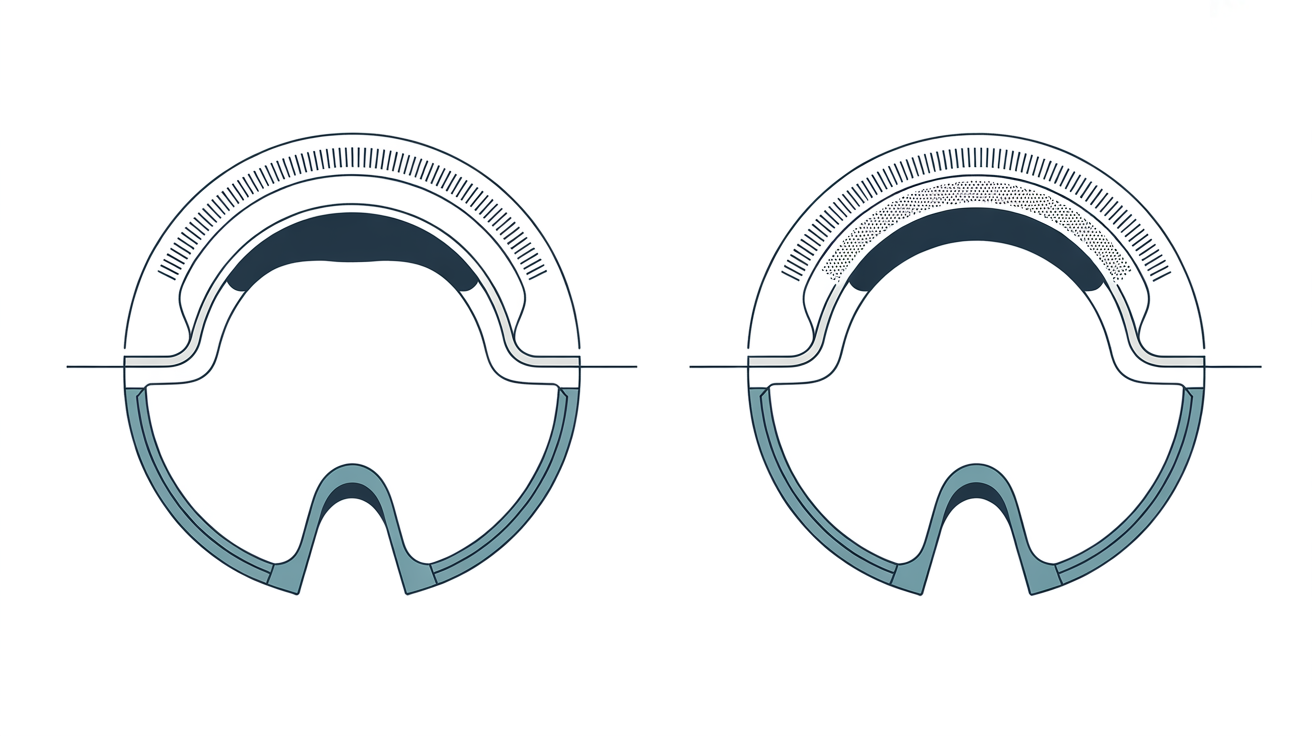
Ento Key, Rigid Contact Lenses calls that interface a fluid lens and states it is zero when the back surface radius matches the front surface of the cornea. According to ODReference, the sign follows the relationship between the two curvatures.
- Lens steeper than the cornea (base curve higher in diopters, smaller in millimeters): the tear lens acts as plus
- Lens flatter than the cornea (base curve lower in diopters, larger in millimeters): the tear lens acts as minus
- Lens on flat K: the fluid lens is zero and ordered power equals the corneal-plane sphere
The locked ODReference example is flat K 44.00 D with a base curve of 45.00 D, which is a tear lens of about +1.00 D. Because the tear lens is subtracted, a plus tear lens makes the ordered lens more minus and a minus tear lens makes it more plus. The calculator above shows the tear lens as its own readout, so the sign is never inferred from the final number alone.
How do millimeters and diopters convert for K readings and base curves?
Keratometry millimeters and diopters convert with D = 337.5 ÷ r and r = 337.5 ÷ D, with r in millimeters.
According to ODReference, MM to Diopter Conversion Calculator, 337.5 is the standardized keratometric refractive index 1.3375 expressed for a radius in millimeters. Flat K, steep K, and the base curve all convert with the same constant, which is why this calculator accepts either unit and reports both.
The following table is recomputed from r = 337.5 ÷ D and rounded to two decimals. The cells are calculated, not pasted from GPLI or ODReference charts.
| Curvature (D) | Radius (mm) |
|---|---|
| 40.00 | 8.44 |
| 41.00 | 8.23 |
| 42.00 | 8.04 |
| 43.00 | 7.85 |
| 44.00 | 7.67 |
| 44.50 | 7.58 |
| 45.00 | 7.50 |
| 46.00 | 7.34 |
| 47.00 | 7.18 |
Two of those rows have independent confirmation. ODReference lists 7.50 mm = 45.00 D and 43.00 D ≈ 7.85 mm. The Ento Key on-K example of 44.50 D is 7.58 mm on the same formula. Enter K readings in whichever unit the keratometer prints; the arithmetic is identical once both values reach diopters.
What do SAM and FAP change when the base curve moves?
SAM means Steeper Add Minus and FAP means Flatter Add Plus when the GP base curve changes.
Changing the base curve changes the tear lens, so the ordered power has to change by the same amount with the opposite sign. The calculator applies that as subtraction rather than as a lookup table, which keeps SAM and FAP consistent with the tear-lens formula above.
Worked SAM. Ordered power −3.00 D on an 8.00 mm base curve. A new base curve of 7.90 mm is 0.10 mm steeper, which is +0.53 D on the exact 337.5 arithmetic. The new starting power is −3.50 D after rounding. Those step sizes match the Opterio base-curve selection guide; the 1:1 diopter match is the ODReference tear-lens formula.
Worked FAP. Ordered power −2.50 D on a 42.00 D base curve. A new base curve of 41.50 D is 0.50 D flatter. The new starting power is −2.00 D.
ODReference gives 0.10 mm ≈ 0.50 D as a working approximation. That approximation is useful at the chair; the calculator supersedes it by converting both radii exactly, which is why 8.00 mm → 7.90 mm reads 0.53 D rather than 0.50 D. Opterio notes that some sources apply a 0.50:1 or 0.75:1 ratio instead of 1:1. This page performs the diopter subtraction and states it; it does not offer a ratio selector.
When does vertex compensation change the ordered GP power?
Vertex compensation changes ordered GP power when the spectacle sphere is at or beyond about ±4.00 D.
Spectacle power is measured at the spectacle plane. A GP lens sits on the cornea, so the sphere is first restated at the corneal plane with Fc = Fs ÷ (1 − d × Fs), d in meters. This site uses a default vertex distance of 12 mm when the refraction does not record one, and the same ±4.00 D gate used across the other calculators.
GPLI, Toric and Spherical Lens Calculator states that powers are vertexed to the corneal plane, and its vertex chart column starts at 4.00. That page does not disclose a vertex distance in millimeters, so 12 mm is this site's default and is not attributed to GPLI.
Vertex first, tear lens second. Reversing the order mixes a spectacle-plane number with a corneal-plane one. Isolate the compensation, or read the 12 mm chart, on the Contact Lens Vertex Calculator and Distance Chart.
When does corneal cylinder push a spherical GP to a toric design?
A spherical GP typically neutralizes up to about 2.00 D of corneal cylinder through the tear lens; above that, the design review is toric or bitoric.
Enter steep K in the calculator and it reports corneal cylinder and flags that threshold. It still returns a spherical starting power — the flag is a design signal, not a toric output.
| Design class | Sourced corneal-cylinder note |
|---|---|
| Spherical GP | GPLI ≤2 D; ODReference about 2.00 D with-the-rule |
| GP toric | GPLI >2 D corneal astigmatism |
| Bitoric | ODReference often 2.00 to 2.50 D or more of corneal toricity |
Above the threshold, residual astigmatism shows up in the over-refraction rather than in this arithmetic. The design decision, the bitoric threshold in full, and the fitting sequence belong to RGP Contact Lens Parameters and Starting Power.
How is this calculator different from the GPLI and Art Optical tools?
This is an independent starting-power calculator, not the GPLI nomogram and not an Art Optical lens-design tool.
The 13 August 2026 SERP for rgp lens calculator ranks GPLI first, Art Optical Standard Lens Design second, and ODReference RGP third. This URL does not impersonate any of them. The following table states what those tools output against what this page computes.
| Tool | What that tool shows | What this calculator does |
|---|---|---|
| GPLI Toric and Spherical Lens Calculator | Bennett spherical nomogram and Quinn GP toric; Ks and refraction in; BCR, OAD, peripheral curves, tear-lens crosses out | Cites the ≤2 D / >2 D threshold and the starting-point honesty. No nomogram, no peripheral-curve engine |
| Art Optical Standard Lens Design | Single, Bi Toric, Back Toric parameters; optical zone; consultation when limits are exceeded | Named as a lab design calculator. No optic zone, no dual-base-curve output |
| ODReference RGP Lens Calculator | Tear lens, SAM/FAP, ordered power from Ks, base curve, and over-refraction | Matches those optics and shows the working. Manufacturer-agnostic |
| Contact Lens Calc, this page | Starting GP power only | Corneal-plane sphere − tear lens, rounded to 0.25 D, with the mm ↔ D conversion and the SAM/FAP change |
Mandell-Moore lives on GPLI as a separate bitoric tool. Ads volume for that query is null and it is not cloned here. Compare independent and manufacturer tools on Contact Lens Calculators: OptiExpert, Simplifit, and Independent Tools.
How do you verify the starting GP power on eye?
Starting GP power is verified with over-refraction after the trial lens settles, not by recalculating the tear lens.
The following four steps close the loop.
- Apply the starting power to a diagnostic lens in the selected base curve.
- Let the lens settle, then assess the fluorescein pattern before trusting any optics.
- Take the over-refraction with that lens in place.
- Combine the residual error with the lens in use, including any SAM or FAP from a base-curve change.
Residual cylinder in the over-refraction is a design question, not a rounding error. Combine the residual with the lens in use on the Over-Refraction Calculator for Contact Lens Parameters. Verify power with over-refraction after the trial lens.
Where does base curve selection happen?
Base curve selection happens before this calculator: the tool takes the base curve you selected as an input and never outputs one.
Converting keratometry into a starting base curve, choosing on K, steeper or flatter as a fitting philosophy, fluorescein assessment, diameter, and empirical versus diagnostic fitting are all how-to work. They live on RGP Contact Lens Parameters and Starting Power, which keeps that intent. This URL takes the calculation only. The base curve as an ordered contact lens parameter is defined on Base Curve of Contact Lenses.
For soft lenses none of this applies, because there is no rigid tear lens. Convert spectacle prescription to contact lens parameters on the Contact Lens Conversion Calculator, and see the full tool inventory on Contact Lens Calculators: Conversion, Vertex, and Toric.
RGP power calculator questions
What is the tear lens in a GP fit?
The tear lens is the fluid layer between the back surface of a rigid lens and the cornea, with power of about base curve (D) − flat K (D).
It has real refractive power, so the ordered lens is calculated around it rather than beside it.
Does a steeper base curve add plus or minus to the ordered power?
A steeper base curve adds minus to the ordered power — Steeper Add Minus.
Steepening creates a plus tear lens, and the ordered lens subtracts it back out.
How do you convert a K reading in millimeters to diopters?
Divide 337.5 by the radius in millimeters: a 7.50 mm radius is 45.00 D.
Reverse it with r = 337.5 ÷ D. The constant is the keratometric index 1.3375 written for millimeters.
Do you vertex before or after subtracting the tear lens?
Vertex the spectacle sphere first, then subtract the tear lens at the corneal plane.
The tear lens already sits at the corneal plane, so compensating afterwards would mix two reference planes.
Is this the GPLI calculator?
No. This is an independent, manufacturer-agnostic starting-power calculator that does not reproduce the GPLI nomogram or its peripheral-curve output.
GPLI is named here as an alternative tool, not as this site's math.
Starting GP power is not a prescription
A calculated GP starting power is not a contact lens prescription and not a lab order.
Not a Rx
Not a prescription / on-eye next step
Fluorescein pattern, diameter, peripheral curves, and final power are decided by a licensed practitioner with the lens on eye. According to GPLI, an empirical result is a starting point toward successful GP wear.
Patient aside (not a substitute for a fitting)
Rigid lenses are fitted to the shape of your cornea, not chosen from a number on a glasses prescription. A calculator can give your practitioner a starting point. Only a fitting decides what you wear.
Starting RGP contact lens parameters remain contact lens parameters at the corneal plane, and they stay unfinished until a fitter checks them on eye. Read the bound on Starting Contact Lens Parameters Are Not a Prescription.
Sources
- ODReference, RGP Lens Calculator — tear lens ≈ base curve (D) − flat K (D); plus when steeper and minus when flatter; the 44.00 / 45.00 → +1.00 D example; SAM/FAP; 0.10 mm ≈ 0.50 D; spherical RGP neutralizes up to about 2.00 D of with-the-rule corneal astigmatism; bitoric often 2.00–2.50 D or more. Diameter bands not used here.
- ODReference, MM to Diopter Conversion Calculator — keratometric index 1.3375; D = 337.5 ÷ r; 7.50 mm = 45.00 D; 43.00 D ≈ 7.85 mm.
- GPLI, Toric and Spherical Lens Calculator — spherical nomogram for ≤2 D of corneal cylinder and GP toric above 2 D; powers vertexed to the corneal plane; 0.25 D rounding option; an empirical result is a starting point, not a first-fit guarantee. Bennett and Quinn nomograms and peripheral-curve output are not cloned; the vertex distance in millimeters is not disclosed there.
- Opterio, base-curve selection guide — D = 337.5 / mm; SAM/FAP at 1:1 with a note that some sources use 0.50:1 or 0.75:1; worked 8.00 → 7.90 mm and 42.00 → 41.50 D examples.
- Ento Key, Rigid Contact Lenses (Stein et al., Fitting Guide for Rigid and Soft Contact Lenses, 4th ed.) — contact lens work first considers the flattest K reading; the fluid lens is zero when the radii match; on-K example 44.50 D / 7.58 mm.
- Art Optical, Standard Lens Design Calculator — Single, Bi Toric and Back Toric parameters with optical zone; named as a lab design tool, not replicated.
- Contact Lens Spectrum, Rules of Thumb (Tony A.J. Phillips and Kristin Bailey, October 2024) — rules of thumb are guides rather than exact engines; BOZD and BOZR increments are not merged here.
Published Last updated Report a correction