What is oxygen transmissibility (Dk/t)?
Oxygen transmissibility is oxygen permeability divided by lens thickness, written Dk/t or Dk/l.
Contact Lens Spectrum, Understanding the Values that Describe Oxygen Flux Through a Contact Lens (January 1998) defines oxygen permeability, Dk, as "an intrinsic physical property of a material that describes in mathematical terms the rate of oxygen flow through that material." The two letters are two coefficients: D is the diffusion coefficient and k is the solubility coefficient. Dk is quoted in Fatt units, also called barrers, after Professor Irving Fatt, who carried out much of the early work on the oxygen permeability of contact lens materials.
Dk on its own says nothing about a lens. It describes a slab of material of unstated thickness. The same source puts it plainly: "Contact lens thickness (l) is the key variable that differentiates contact lens transmissibility (Dk/l) from material permeability (Dk)." Divide the material property by the thickness of an actual lens and you get Dk/t, the transmissibility of that lens, conventionally reported in units of ×10⁻⁹.
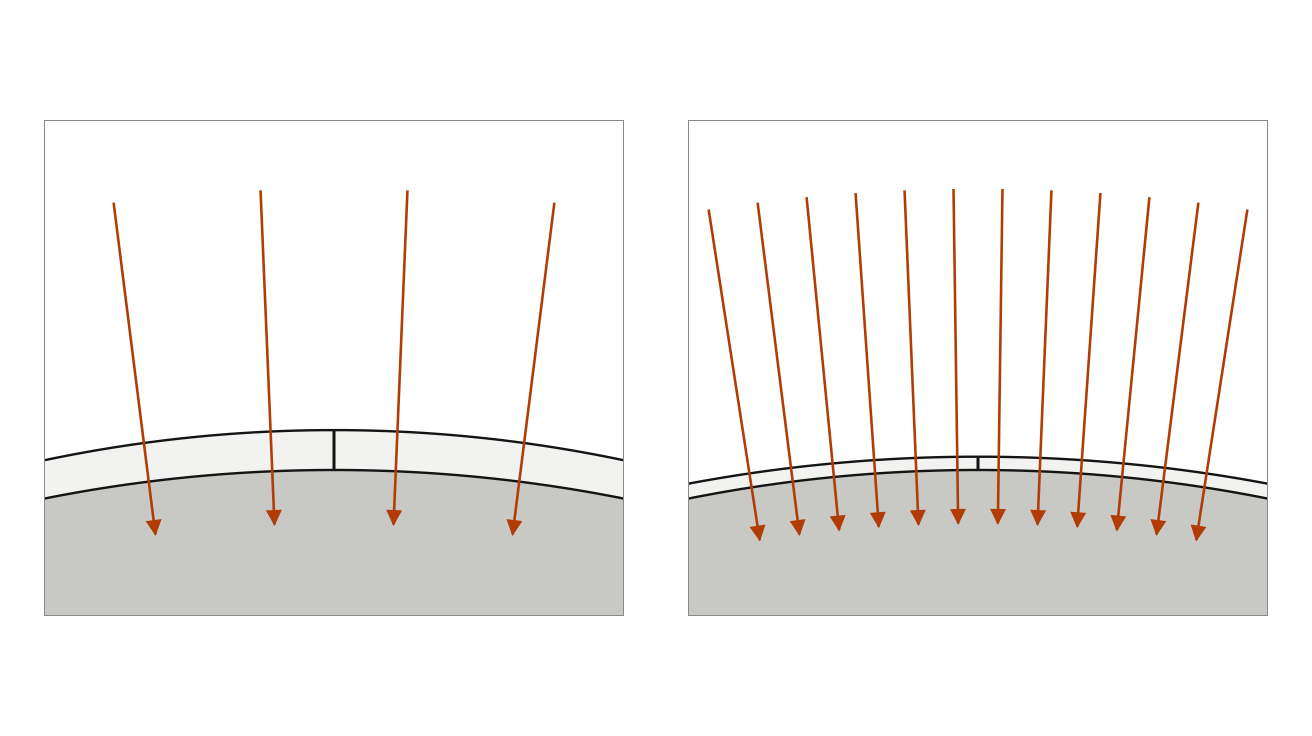
Both panels above are the same material on the same cornea. Only the centre thickness differs, and the oxygen reaching the tissue moves with it — which is why a Dk quoted without a thickness is not yet a claim about any lens a patient wears.
Which thickness? By convention, the center thickness. Contact Lens Spectrum, The Role of Oxygen in Successful Lens Wear (May 2006) flags the limitation directly: "the only published lens thickness is the center thickness, which allows for information on how much oxygen is delivered only to a small central region of the cornea." Values can also be calculated from zonal or harmonic mean thickness, and the choice is not cosmetic — the 1998 source reports that different thickness conventions produced 23 to 36 Dk/l units for identical −3.00 D lens designs, a 64 percent spread on the same lens.
One related term appears in older literature. Equivalent oxygen percentage (EOP) describes oxygen flux "as if the eye were responding to various amounts of atmospheric oxygen," which lets a practitioner relate a calculated Dk/t to observed corneal edema. It carries the same methodological caveat: reported EOP for one condition has ranged from 6.24 percent to 19.51 percent depending on how it was derived.
How much oxygen transmissibility is enough?
The published minimum for daily wear is 24 Dk/t units and for closed-eye wear 87, with a later review arguing the closed-eye figure should be at least 125.
The following table lists oxygen sufficiency criteria as stated by published sources. It is a table of research thresholds. It is not a product comparison, and it is not a clearance to sleep in a lens.
| Source | Stated Dk/t | Condition |
|---|---|---|
| Holden & Mertz 1984, quoted in Contact Lens Spectrum (May 2006) | 24 | Open eye — minimum to prevent lens-induced corneal edema |
| Holden & Mertz 1984, same source | 87 | Closed eye — minimum to prevent lens-induced corneal edema |
| Harvitt 1999, tabulated in Contact Lens Spectrum (May 2006) | 89 | Absence of epithelial anoxia during extended wear |
| Fonn & Bruce, Eye & Contact Lens 2005;31(6) | at least 125 × 10⁻⁹ | Extended wear — revised criterion |
Fonn and Bruce reviewed what the original 1984 figures rested on: a no-lens closed-eye corneal edema level of 4 percent, and a single silicone lens data point at Dk/t 182 with a closed-eye edema level of 2.6 percent. With better measurements of both, their conclusion is that "the Holden and Mertz criteria for extended-wear critical Dk/t should be revised upwards to at least 125x10."
Higher is not indefinitely better. Contact Lens Spectrum (May 2006) describes corneal oxygen uptake slowing "as the supply of oxygen closes in on meeting corneal demand," reaching a steady state, with the response leveling off asymptotically near a Dk of approximately 30 for the open eye and 80 for the closed eye. Past that, "increases in Dk/t beyond this value certainly have less of an impact in terms of oxygen utilization." A larger number on a box is not automatically a better outcome for a given eye.
How does water content change oxygen transmissibility?
In a conventional hydrogel, oxygen travels through the water, so permeability rises with water content — and stops rising at the permeability of water itself.
Contact Lens Spectrum (January 1998) states that "Dk is exponentially dependent upon the water content rather than the chemical composition of the hydrogel material," and that "the maximum limit for hydrogel materials is 80 Dk units." Contact Lens Spectrum, Silicone Hydrogel Material and Surface Properties (March 2002) supplies the reason: "100 percent water has a Dk of about only 80 barrers." A hydrogel cannot out-perform the medium doing the transporting.
Water content is also how soft materials are classified. Review of Optometry, Understanding the Influence of Water Content in Soft Lenses (Langis Michaud, 15 August 2023) lists the US FDA groups:
- Group I — low water (under 50 percent), non-ionic
- Group II — high water (over 50 percent), non-ionic
- Group III — low water, ionic
- Group IV — high water, ionic
- Group V — created later, specifically for silicone hydrogel materials
The same article puts HEMA-based water content across a range "from 30% to 80%," and notes the trade that comes with it: free water evaporates first, and "a dehydrated lens will be more uncomfortable and will perform less well optically." Water content therefore reads two ways at once — as an oxygen route in hydrogels, and as a dehydration and comfort variable in every material.
Hydrogel or silicone hydrogel: what changes?
Silicone hydrogels carry oxygen through the silicone phase instead of the water, which breaks the link between high water content and high permeability.
Contact Lens Spectrum (March 2002) gives the two anchor numbers side by side: 100 percent water is about 80 barrers, while pure silicone rubber is "in excess of 300 barrers." Once silicone is doing the transporting, water content is no longer the lever. Review of Optometry (2023) describes the consequence — "the introduction of silicone disrupted the established relationship between water content and oxygenation" — and notes that first-generation silicone hydrogels combined very low water content with transmissibility that was nonetheless far above any HEMA lens.
As a class, the 2002 source reports silicone hydrogel transmissibility of 110 to 175 × 10⁻⁹, against a conventional hydrogel comparison at Dk/t 22. Read those as class physics. Do not read them as a ranking of products.
Two practical consequences follow, and both are fitting decisions rather than shopping decisions:
- In a hydrogel, asking for more oxygen means asking for more water, which means accepting the dehydration behavior that comes with it — and a hard ceiling near 80 Dk units.
- In a silicone hydrogel, water content and oxygen are largely decoupled, so water content is chosen for comfort, wettability, and handling rather than for oxygen.
What is contact lens modulus, and is it the same thing?
Modulus is the stiffness of the lens material, measured in megapascals (MPa). It is a mechanical property, not an oxygen property.
Review of Optometry (2023) records the history that made modulus a fitting concern: early silicone hydrogels had "much higher modulus (and hence stiffness) than HEMA lenses, resulting in greater wearer irritation," and second-generation materials brought modulus down "from roughly 1.3 MPa on average down to about 0.6 MPa on average," adopting the modulus of hydrogel lenses.
Modulus belongs in a fitting conversation because it changes how a lens drapes, how it handles, and how it interacts with the lid and the conjunctiva. It does not appear anywhere in Dk/t. A stiffer lens is not a more permeable one, and a high-Dk material is not automatically a comfortable one. Read the two properties separately, and confirm both at the slit lamp rather than on a specification sheet.
Why this page does not publish Dk/t by brand
A published Dk/t value describes one material at one center thickness, usually a −3.00 D lens. It is not the transmissibility of the lens your patient is actually ordered.
Three measured facts make a brand table misleading rather than merely unmaintainable:
- Power changes the divisor. Center thickness measured across a normal power range spanned 0.056 mm to 0.243 mm in the study cited below, and the transmissibility calculated from it spanned roughly 9.5 to 246 units.
- Thickness convention changes the answer. Center, zonal, and harmonic mean thickness produced 23 to 36 Dk/l units on identical −3.00 D designs (Contact Lens Spectrum, 1998).
- Laboratory method changes the answer. Published Dk for a single 58 percent hydrogel material has ranged from 22 to 35 Fatt units — a 63 percent variation — from edge correction, boundary-layer effects, electrode shape, temperature, and inter-laboratory differences alone.
This site is manufacturer-agnostic. Read a specific figure from the manufacturer's own current literature for the exact design and power you intend to order, and read the principle here. A number copied from a third-party table, quoted at a power nobody ordered, is not clinical information.
How does the power you order change Dk/t?
Power changes center thickness, and center thickness is the divisor — so the same material delivers different transmissibility at different powers.
Lira, Pereira, Real Oliveira and Castanheira measured this directly (Contact Lens & Anterior Eye 2015;38(2), PMID 25554499). They took four daily disposable and five monthly or biweekly designs at each brand's maximum minus power, −6.00 D, −3.00 D, plano, +3.00 D and +6.00 D, measured center and paracentral thickness with an electronic gauge, and recalculated transmissibility from the manufacturers' permeability figures. For monthly and biweekly lenses, center thickness ran from 0.061 ± 0.002 mm to 0.243 ± 0.002 mm and transmissibility from 39.4 ± 0.3 to 246.0 ± 14.4 units. For daily disposables, center thickness ran from 0.056 ± 0.0016 mm to 0.205 ± 0.002 mm and transmissibility from 9.5 ± 0.5 to 178.1 ± 5.1. Their conclusion names the clinical situation exactly: practitioners "must have this fact in account when high power plus or minus lenses are fitted or when continuous wear is considered."
Plus lenses are the thick ones centrally. Minus lenses are thin centrally and thicken toward the edge. So a plus prescription and a minus prescription of the same nominal magnitude do not arrive at the same Dk/t in the same material.
That matters here because the power on the box is not the power on the spectacle Rx. This site converts spectacle power to the corneal plane with Fc = Fs ÷ (1 − d × Fs), at a default vertex distance of 12 mm, applied when the meridian is at or beyond about ±4.00 D, and rounded to the nearest 0.25 D:
| Spectacle power | Compensated at 12 mm | Ordered power (0.25 D steps) |
|---|---|---|
| −8.00 D | −7.2993 D | −7.25 D |
| −6.00 D | −5.5970 D | −5.50 D |
| +6.00 D | +6.4655 D | +6.50 D |
| +8.00 D | +8.8496 D | +8.75 D |
| ±3.00 D | below the ±4.00 D gate | ±3.00 D as written |
Minus spectacle lenses gain effective power at the cornea, so the ordered contact lens is less minus — and slightly thinner centrally. Plus spectacle lenses lose effective power at the cornea, so the ordered contact lens is more plus, and thicker centrally. At ±6.00 D the two ordered values differ by a full 1.00 D of lens power in opposite directions. Calculate the ordered power on the Contact Lens Conversion Calculator or the Vertex Distance Calculator first; the transmissibility question only becomes concrete once you know which power is going on the order.
Where does the t in Dk/t come from?
The t in Dk/t is the center thickness of the finished lens, and that value is defined, measured, and labeled on a different page.
Center and Edge Thickness of Contact Lenses owns thickness as geometry: what the number is, how it is measured, what a printed value means, and how it changes handling. This page owns only what that number does to corneal oxygen once it becomes a divisor. The two collide by construction — the t in Dk/t is that thickness — so the border is geometry on that page, consequence on this one.
When does Dk/t change which parameter set you order?
Transmissibility changes the material and design you order, never the converted power.
Situations where the number is worth checking before the order goes out:
- High plus. The thickest center thickness in the design, and the lowest transmissibility that design will produce.
- High minus at a design's power limit. Center thickness is small, but edge and junction thickness are not, and published Dk/t describes the center only.
- Thick designs. Toric ballast and multifocal optics add material that a center-thickness figure does not describe. Calculate starting sphere, cylinder, and axis on the Toric Contact Lens Calculator, then treat material as a separate decision.
- Extended or continuous wear. This is where the criteria diverge most (87 versus at least 125), and where the prescribing decision belongs entirely to the practitioner.
- A cornea already showing a response. Edema, neovascularization, or limbal hyperemia are on-eye findings, and they are addressed at the slit lamp rather than by arithmetic.
None of these is a reason to alter the converted power. The converted power is the optical answer; material and design are the physiological one. The full ordered set is listed on Contact Lens Parameters.
Starting contact lens parameters still require on-eye fit
Dk/t is calculated from a material and a thickness. The corneal response is measured on the patient, and only the second one is evidence.
A criterion of 24, 87, 89, or 125 units is a research threshold derived from group data on corneal swelling. It is not permission for a wear schedule, and it does not describe how one cornea will behave overnight. Convert spectacle prescription to contact lens parameters for power, fit base curve and diameter on eye, verify the result with over-refraction, and check the cornea at follow-up.
Patient aside (Grade 8–9)
"Dk/t" is a number for how much oxygen gets through a contact lens. It depends on what the lens is made of and how thick it is — and thickness changes with your prescription, so two people wearing the same brand can get different numbers. It does not tell you whether you can sleep in your lenses. Only the eye-care practitioner who fitted you can answer that, after looking at your eyes.
Read Starting Contact Lens Parameters Are Not a Prescription for the bound that applies across this site. Contact lens parameters at the corneal plane stay unfinished until a licensed practitioner has checked them on eye.
Sources
Clinical claims on this page are attributed to the publications below.
- Contact Lens Spectrum, Understanding the Values that Describe Oxygen Flux Through a Contact Lens (January 1998) — Dk as an intrinsic material property; D as diffusion coefficient and k as solubility coefficient; Fatt units; thickness as the variable separating Dk/l from Dk; center, zonal, and harmonic mean thickness conventions producing 23 to 36 Dk/l units on identical −3.00 D designs; maximum of 80 Dk units for hydrogel materials; Dk exponentially dependent on water content; 22 to 35 Fatt units of published variation for one 58 percent material; EOP and its 6.24 to 19.51 percent methodological spread.
- Contact Lens Spectrum, The Role of Oxygen in Successful Lens Wear (May 2006) — Holden and Mertz minimum transmissibility of 24 and 87 Dk/t units for open and closed eye; Harvitt 1999 at 89 Dk/t for absence of epithelial anoxia in extended wear; asymptotic leveling near Dk 30 open eye and 80 closed eye; the caveat that published thickness is center thickness only.
- Fonn D, Bruce AS. A review of the Holden-Mertz criteria for critical oxygen transmission. Eye & Contact Lens 2005 Nov;31(6). PMID 16284501— the 4 percent no-lens closed-eye edema level and the Dk/t 182 silicone data point behind the original criterion; conclusion that extended-wear critical Dk/t should be revised upwards to at least 125x10.
- Lira M, Pereira C, Real Oliveira MECD, Castanheira EMS. Importance of contact lens power and thickness in oxygen transmissibility. Contact Lens & Anterior Eye 2015 Apr;38(2). PMID 25554499— center and peripheral thickness measured across powers from each brand's maximum minus through +6.00 D; center thickness 0.061–0.243 mm (monthly and biweekly) and 0.056–0.205 mm (daily disposable); transmissibility 39.4–246.0 and 9.5–178.1 respectively; conclusion that power significantly changes thickness and therefore transmissibility, and that this matters for high-power plus or minus fits and continuous wear.
- Contact Lens Spectrum, Silicone Hydrogel Material and Surface Properties (March 2002) — 100 percent water at about 80 barrers; silicone rubber in excess of 300 barrers; silicone hydrogel transmissibility of 110 to 175 × 10⁻⁹ as a class against a conventional hydrogel comparison at Dk/t 22; oxygen transmitted through the silicone component rather than the water.
- Michaud L. Understanding the Influence of Water Content in Soft Lenses. Review of Optometry, 15 August 2023— FDA groups I to IV by water content and ionicity and Group V for silicone hydrogels; HEMA water content from 30 to 80 percent; silicone disrupting the established relationship between water content and oxygenation; modulus falling from roughly 1.3 MPa to about 0.6 MPa between silicone hydrogel generations; dehydration and comfort.
Formulas and constants on this page match the site's conversion module: Fc = Fs ÷ (1 − d × Fs), a 12 mm default vertex distance, a ±4.00 D meridional gate, and rounding to the nearest 0.25 D. See How we calculate.
Published Last updated Report a correction