What is the peripheral curve system?
It is the sequence of progressively flatter radii cut outside the back optic zone, to follow a cornea that flattens toward the limbus.
According to Ento Key, Rigid Contact Lenses: Basics (Stein, Slatt, Stein and Freeman, Fitting Guide for Rigid and Soft Contact Lenses), the cornea has a central cap of roughly 4 mm to 6 mm with a relatively constant radius, surrounded by a much flatter paracentral zone that does not flatten to any neat mathematical progression — it is aspheric. A single spherical back curve carried out to the edge would stand off that periphery badly, so the design steps down in curves instead.
The names on an order follow the sequence outward:
- Secondary curve — the first curve outside the optic zone. That chapter puts it at 2.00 D to 7.00 D flatter than the base curve, with a width that can be as narrow as 0.2 mm.
- Intermediate curve — a curve sitting between the base curve and the peripheral curve. On a standard tricurve it is described as about 1 mm flatter than the base curve.
- Peripheral curve — the outermost and much flattest curve, quoted on that standard tricurve as a 12.25 mm radius, with peripheral curves 0.4 mm to 0.8 mm flatter than the base curve and about 1.3 mm wide.
- Blend — the transition between two adjacent radii, cut with a tool whose radius falls between them. A light blend leaves the zones identifiable; a heavy blend runs them into each other.
According to Ento Key, Rigid Corneal Lens Design and Fitting (Contact Lens Practice), that peripheral zone is generally 1 mm to 2 mm wide in total and composed of one to four peripheral curves. Tricurve designs are probably the most commonly used form; bicurve designs appear on small lenses below about 8.5 mm; tetracurve and other multicurve designs are used on larger lenses or where a smoother transition between zones is wanted. Aspheric designs replace the sequence with continuous flattening, though most still carry a much flatter, often spherical, peripheral zone about 0.2 mm wide to avoid mechanical irritation when the lens decentres.
How does the peripheral curve system produce edge lift?
Flattening the periphery lifts the lens edge away from the continuation of the base curve — that gap is edge lift, and what it opens over a real cornea is edge clearance.
According to Contact Lens Update (CORE), Edge lift, the general definition in lens geometry is the distance between an extension of the back central optic radius and the absolute edge of the lens. The design chapter above draws the distinction that matters on an order: edge clearance relates the lens to the cornea, while edge lift relates to the lens only. A lens has an edge lift before it is ever applied; it has an edge clearance only on a given eye.
The gap is not cosmetic. Without a peripheral gap between the edge of the lens and the cornea, that chapter states, mechanical pressure leads to superficial corneal damage; the gap is also what makes tear exchange possible and what lets the lids get under the lens for removal. It gives a minimum axial edge clearance of 60 to 80 µm with the lens centred as the optimal value, and in its comparison of design types quotes usual edge clearance of 80 to 120 µm for spherical designs against 60 to 90 µm for aspheric ones.
Design philosophies differ on which value to hold constant. That chapter notes that some designs keep edge lift constant across the whole range of back optic zone radii, which produces greater edge clearance at the flatter end of the range, and calls a design that gives constant edge clearance for corneas of similar asphericity the superior approach.
Axial or radial: which edge lift does the laboratory mean?
Two measurements share the name, and they are not the same number — axial edge lift is always larger than radial edge lift for the same lens.
According to Contact Lens Spectrum, Axial vs. Radial Edge Lift and Edge Clearance: Defining the Terms (Keith Parker, NCLC, October 1997), axial edge lift is the distance between the apex of the lens edge and the continuation of the base curve measured parallel to the lens axis, while radial edge lift is that same distance measured along the radius of, or normal to, the base curve. Most computerised numerical controlled lathing calculations are performed in terms of axial edge lift, so a radial value handed to a laboratory that reads it as axial produces a lens other than the one intended.
That article gives the working conversions: a normal peripheral system runs a radial edge lift of 0.08 mm to 0.10 mm, equal to an axial edge lift of approximately 0.11 mm to 0.14 mm depending on diameter; an axial edge clearance of 0.08 mm equals a radial edge clearance of about 0.065 mm at a 9.0 mm diameter on an average cornea. The rule of thumb it closes on: axial edge lift or clearance is always more than radial, and the larger the lens diameter, the greater the difference.
It also states the limit of calculating any of this. Edge clearance can only be computed if the corneal rate of flattening — the eccentricity — is known, conventional keratometry does not supply it, and topographic averages will never make the calculation entirely accurate. That article's conclusion is the same one this site reaches from every direction: the best way to determine the edge clearance of a lens is fluorescein evaluation, which is read on Fluorescein Patterns and Fit Troubleshooting of GP Lenses.
How do optic zone, peripheral curves, and overall diameter add up?
The optic zone is the overall diameter minus the width of the peripheral curves, so widening the periphery narrows the powered zone.
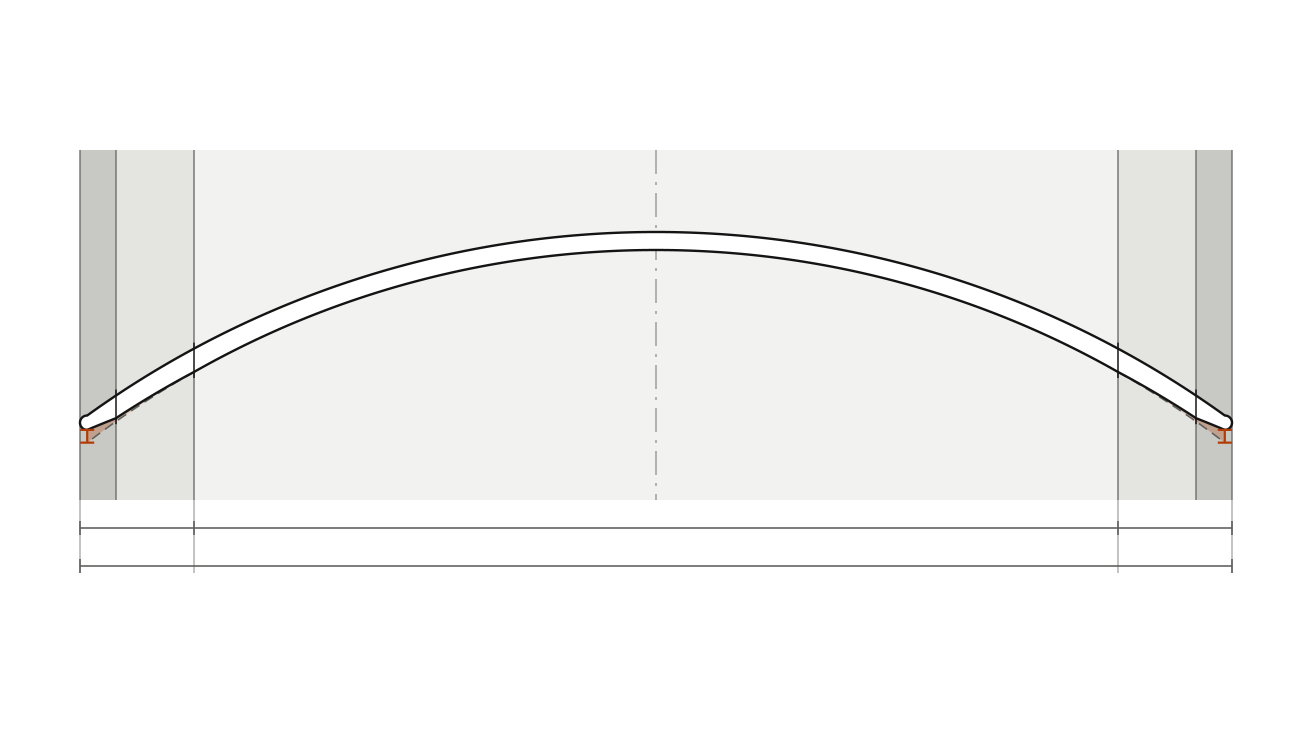
Ento Key's basics chapter states that relationship directly, and adds why the curves are there at all: to allow tear flow under the lens at the flatter corneal periphery. The design chapter adds the ordering consequence — if the back optic zone diameter is reduced while the total diameter is held, the periphery becomes wider and flatter peripheral curves are then required to maintain the same edge clearance.
Changing either number also changes the sagittal depth, which is the fitting relationship the whole back surface produces. That chapter's rule of thumb is that an increase in back optic zone diameter of 0.5 mm requires an increase in back optic zone radius of about 0.05 mm to keep a clinically equivalent fit, because reducing the optic zone without reducing the radius leaves a shallower vault and therefore a flatter fit. Overall diameter as an ordered field is on Diameter of Contact Lenses, and the vault those values produce together over a stated chord is on Sagittal Depth of Contact Lenses.
On a toric back surface the periphery usually follows the base curves rather than staying spherical, so the optical zone stays round rather than oval — the design context for that is on Bitoric GP Contact Lenses: Design and Power Effect.
What do excessive and insufficient edge lift look like?
Too much edge lift is felt by the lid and breaks alignment at the edge; too little seals the lens down and stops tear exchange.
The Contact Lens Update entry describes the excessive case: where the base curve is too flat, the edge lifts so far that lens alignment with the cornea is interrupted, the lens often rides on the lower lid margin, and the patient reports varying degrees of discomfort. It records the alternative names practitioners use for that appearance — lens fluting, or lens buckling.
The insufficient case appears on the fluorescein pattern instead of in the symptom. A thin or minimum peripheral clearance eventually leads to poor tear exchange and possible sealoff, while excessive clearance causes excessive movement and lid interaction; both are read at the lens edge with dye. Ento Key's design chapter adds the comfort mechanism from the other side: the shape of the lens edge is one of the most important factors in minimising discomfort, and good rounding of the front-surface edge has been shown to matter more than rounding of the posterior edge — evidence that the edge interacts more critically with the eyelid than with the cornea.
Edge lift is also how a design is aimed at a fitting philosophy. The 1997 Contact Lens Spectrum article states there will never be one optimum edge lift for everyone: the philosophy — interpalpebral against lid attachment — the environment, and corneal eccentricity all dictate what is required. A lower edge lift suits an interpalpebral lens that must not catch the lid; a higher edge lift gives the upper lid something to grip on a lid-attachment fit, at the cost of more lens awareness.
Why peripheral curves are ordered but rarely verified
A peripheral curve radius can only be read on the bench when the curve is wide enough to measure, and most are not.
The live RGP Contact Lens Parameters and Starting Power guide records that limit from Ento Key's verification chapter: a peripheral curve radius can be read on a radiuscope only when it is at least 1 mm wide, so peripheral curves are typically not a parameter the practitioner verifies. Given widths quoted as low as 0.2 mm, that covers most designs in use. The practical consequence is that the peripheral system is trusted to the laboratory and judged on eye — which is exactly why the fluorescein picture at the lens edge carries so much weight in a GP fit.
Read GP Contact Lens Design: Zones, Curves, and Edge Lift for the full ordered set these curves belong to, and Starting Contact Lens Parameters Are Not a Prescription for the bound that applies across this site.
Patient aside (Grade 8–9)
The back of a hard lens is not one smooth bowl. It has a curved centre and flatter rings around it, and the small gap those rings leave is what lets your tears flow under the lens. If the edge feels sharp or the lens keeps sliding, that gap is what your practitioner will change.
Sources
Clinical claims on this page are attributed to the publications below.
- Contact Lens Spectrum, Axial vs. Radial Edge Lift and Edge Clearance: Defining the Terms(Keith Parker, NCLC, October 1997) — axial edge lift measured parallel to the lens axis and radial along the base curve radius; CNC lathing performed in axial terms; radial 0.08–0.10 mm against axial 0.11–0.14 mm; axial 0.08 mm edge clearance as about 0.065 mm radial at 9.0 mm; axial always greater than radial and the gap widening with diameter; edge clearance calculable only from corneal eccentricity, with fluorescein the best determination; edge lift dictated by fitting philosophy, environment and eccentricity.
- Ento Key, Rigid Corneal Lens Design and Fitting(Contact Lens Practice) — edge clearance as lens-to-cornea against edge lift as lens-only; minimum axial edge clearance 60–80 µm; spherical 80–120 µm against aspheric 60–90 µm; peripheral zone 1–2 mm with one to four curves; tricurve most common, bicurve below about 8.5 mm, tetracurve on larger lenses; aspheric peripheral zone about 0.2 mm; constant edge lift against constant edge clearance; 0.5 mm BOZD against 0.05 mm BOZR; front-surface edge rounding more important than posterior.
- Ento Key, Rigid Contact Lenses: Basics(Stein, Slatt, Stein and Freeman, Fitting Guide for Rigid and Soft Contact Lenses) — corneal cap of 4–6 mm and an aspheric periphery; secondary curve 2.00–7.00 D flatter with widths as narrow as 0.2 mm; standard tricurve peripheral curves 0.4–0.8 mm flatter at 1.3 mm width, intermediate curve 1 mm flatter, peripheral curve at a 12.25 mm radius; the blend and light against heavy blending; optic zone as diameter minus peripheral curve widths; peripheral curves existing to allow tear flow.
- Contact Lens Update (Centre for Ocular Research and Education), Edge lift— edge lift as the distance between an extension of the back central optic radius and the absolute edge of the lens, axial when measured parallel to the optical axis and radial when measured along the radius; a too-flat base curve interrupting alignment and riding the lower lid margin; lens fluting and lens buckling as alternative expressions.
Published Last updated Report a correction